Converting equations into constraints
回答済み
The model contains the following sets and variables:
# sets
u = ['u1', 'u2',...
g = ['g1', 'g2',...
i = ['i1', 'i2',...
k = ['k1', 'k2',...
l = ['l1', 'l2',...
v = ['v1', 'v2',...

# parameters
R_k = {'k1': 3, 'k2': 5, ...

# decision variables
Q_ug = {('u1','g1'): 15, ('u1','g2'): 42, ...
Q_gi = {('g1','i1'): 62, ('g1','i2'): 21, ...
Q_klh = {('k1','l1','h1'): 1000, ('k1','l1','h2'): 1200, ...
Q_kvh = {('k1','v1','h1'): 1500, ('k1','v1','h2'): 2100, ...
Q_hi = {('h1','i1'): 800, ('h1','i2'): 1200, ...
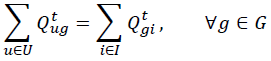
I have the following equations that I want to add to my model as a constraint.
(1)
(2)

I tried to convert them into constraints as follows:
# (1)
m.addConstrs(gp.quicksum(Q_ug[a, b] for a in u) == gp.quicksum(Q_gi[b, c] for c in i) for b in g)

# (2)
m.addConstrs(gp.quicksum(Q_klh[a, b, c] for b in l) + gp.quicksum(Q_kvh[a, b, c] for b in v) == gp.quicksum(Q_hi[c, b] for b in i) * R_k[a] for a in k for c in h)
Am I doing this correctly? The exercises I found were only dealing with simpler equations and less variables, so I am not sure if this is the correct way to convert them using Gurobi.
Appreciate any help! Thanks!
0
-

-
Gurobi Staff
Your constraints look ok. But you also need to define your decision variables as Gurobi variables, for example
Q_ug = m.addVars(u, g, vtype=gp.GRB.INTEGER, name="Q_ug")
You can also write a model file in the end with m.write("Test.lp") and check if the formulation looks like you expected.
0 -
サインインしてコメントを残してください。
コメント
1件のコメント