Three conditions in the objective function
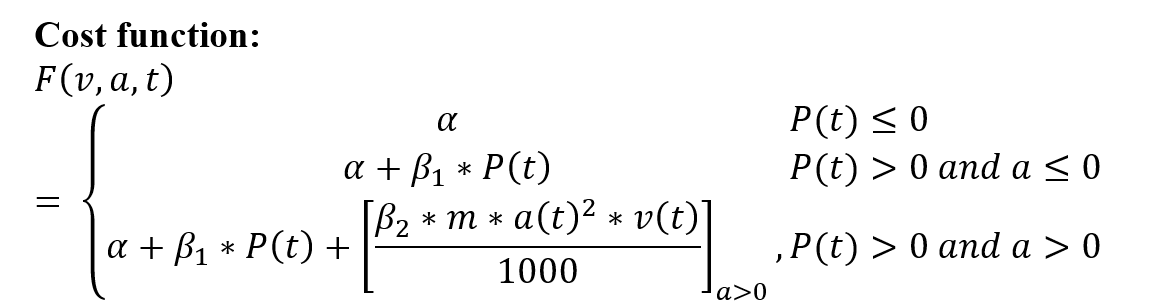
AnsweredI am trying to model three conditions in the objective function, which is shown as below. In this function, alpha, beta1, beta2 and m are all constants and the rest of symbols represent variables that are to be determined during the optimization process. I am not sure how to model these three conditions efficiently with Gurobi. Thank you for any help.
-

I noticed three are several posts discussing how to model conditional constraints with Gurobi. But there currently is not a particular example or demonstration how to model three conditions (and even nested conditions). I hope this post can accomodate such insufficiency.
0 -
-

-
Gurobi Staff
Hi Shaojie,
You can express this type of objective using auxiliary variables. Please find below some comments and a code example that I hope will help you with your problem.- Gurobi can handle bilinear terms, so for each multiplication of more than two variables, we need to define auxiliary variables until we are left with only bilinear terms; here they are called a_squared, term_1, and term_2.
- To activate and deactivate terms of the objective function, we need conditional variables; here, they are called p_positive and a_positive.
- Because the third case of your objective function depends on two conditions, I added another auxiliary variable (p_and_a_positive) which is positive if both a and p are positive, using a general constraint
M = 1e6 # Big M
E = 1e-6 # Epsilon

p_positive = model.addVars(T, vtype=GRB.BINARY)
a_positive = model.addVars(T, vtype=GRB.BINARY)
for t in T:
    model.addConstr(p[t] >= E-M*(1-p_positive[t])) # truly smaller than, using Epsilon
    model.addConstr(p[t] <= M*p_positive[t])
    model.addConstr(a[t] >= E-M*(1-a_positive[t])) # truly smaller than, using Epsilon
    model.addConstr(a[t] <= M*a_positive[t])
p_and_a_positive = model.addVars(T)
for t in T:
    model.addGenConstrAnd(p_and_a_positive[t], [p_positive[t], a_positive[t]])

a_squared = model.addVars(T)
for t in T:
    model.addConstr(a_squared[t] == a[t]**2)
term_1 = model.addVars(T)
for t in T:
    model.addConstr(beta_1*p[t] == term_1[t])
term_2 = model.addVars(T)
for t in T:
    model.addConstr((beta_2*m*a_squared[t]*v[t])/1000 == term_2[t])

model.setObjective(gp.quicksum(alpha + p_positive[t]*term_1[t] + p_and_a_positive[t]*term_2[t] for t in T))
0 -
-
Thank you very much. I think this solution (the code) is very helpful and I can learn a lot from these codes.
0 -
Please sign in to leave a comment.
Comments
3 comments