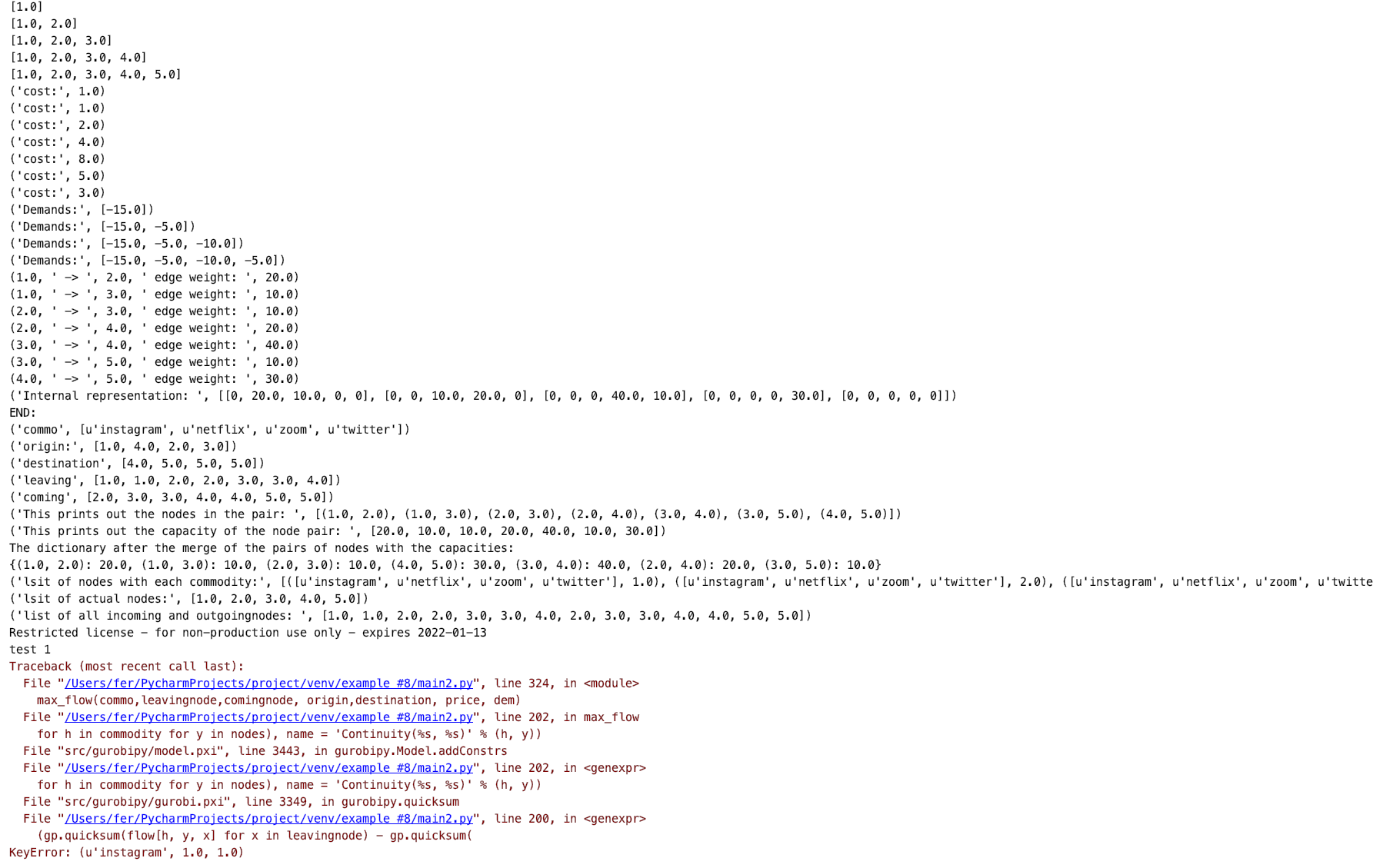
I can't get the flows to print out at all.
Answeredimport gurobipy as gp
def max_flow(commodity,leavingnode,commingnode, origin,destination,cost,demandz):
global graph
global vertices_no
global vertices
global weight
listkeyPair=[]
for i in range(vertices_no):
for j in range(vertices_no):
if graph[i][j] != 0:
listkeyPair.append((vertices[i], vertices[j]))
print("This prints out the nodes in the pair: ",listkeyPair)
listvalueCap=[]
for i in range(vertices_no):
for j in range(vertices_no):
if graph[i][j] != 0:
listvalueCap.append((graph[i][j]))
print("This prints out the capacity of the node pair: ", listvalueCap)
pair,capacity = gp.multidict(dict(zip(listkeyPair, listvalueCap)))
print("The dictionary after the merge of the pairs of nodes with the capacities:")
print (capacity)
listnodes=[]
#for a in range(1):
for i in range(vertices_no):
listnodes.append((commodity,vertices[i]))
print("lsit of nodes with each commodity:", listnodes)
listactualnodes = []
for i in range(vertices_no):
listactualnodes.append((vertices[i]))
print("lsit of actual nodes:", listactualnodes)
nodes =leavingnode +commingnode
print("list of all incoming and outgoingnodes: ", nodes)
# Create optimization model
m = gp.Model('netflow')
# Create variables
# flow = m.addVars(test,di, obj=cost, name="flow")
flow = m.addVars(commodity, pair, obj=cost,vtype = "C", name="flow")
# m.setObjective(flow.prod(cost), GRB.MINIMIZE)
m.update()
# Arc-capacity constraints
for x, y in pair:
m.addConstr(sum(flow[h, x, y] for h in commodity) <= capacity[x, y], "cap[%s, %s]" % (x, y))
Continuity = {}
for h in commodity:
for y in nodes:
for a in range(len(commodity)):
if y == origin[a]:
print("test 1")
m.addConstrs(
(gp.quicksum(flow[h, y, x] for x in commingnode) - gp.quicksum(
flow[h, x, y] for x in leavingnode) == abs(demandz[h,y])
for h in commodity for y in nodes), name = 'Continuity(%s, %s)' % (h, y))
elif y == destination[a]:
print("test 2")
m.addConstrs(
(gp.quicksum(flow[h, y, x] for x in commingnode) - gp.quicksum(
flow[h, x, y] for x in leavingnode) == demandz[h,y]
for h in commodity for y in nodes) , name= 'Continuity(%s, %s)' % (h, y))
else:
print("test 3")
m.addConstrs(
(gp.quicksum(flow[h, y, x] for x in commingnode) - gp.quicksum(
flow[h, x, y] for x in leavingnode) == 0
for h in commodity for y in nodes), name= 'Continuity(%s, %s)' % (h, y))
# Compute optimal solutions
m.optimize()
print (m.display())
print("if model fesible it will print a 2 .", m.status)
# Print solution
# print solution: optimal value and optimal point
print('Obj: %g' % m.objVal)
#print(f"optimal value = {model.objVal:.2f}")
for var in m.getVars():
#print('%s %g' % (v.varName, v.x))
if var.X > 0:
var_names.append(str(var.varName))
var_values.append(var.X)
-
Official comment

-
Gurobi Staff
This post is more than three years old. Some information may not be up to date. For current information, please check the Gurobi Documentation or Knowledge Base. If you need more help, please create a new post in the community forum. Or why not try our AI Gurobot?. -
-

-
Hi Fernanda,
Please note that it is not possible to reproduce the error from the code snippet you provided, because the call of the \(\texttt{max_flow}\) function is missing.
The error you see
  (gp.quicksum( flow[h, y, x] for x in leavingnode) - gp.quicksum(
KeyError: (u'instagram', 1.0, 1.0)
states that there is no object \(\texttt{flow[u'instagram', 1.0, 1.0]}\).
Best regards,
Jaromił0 -
-

Hi Jaromil,
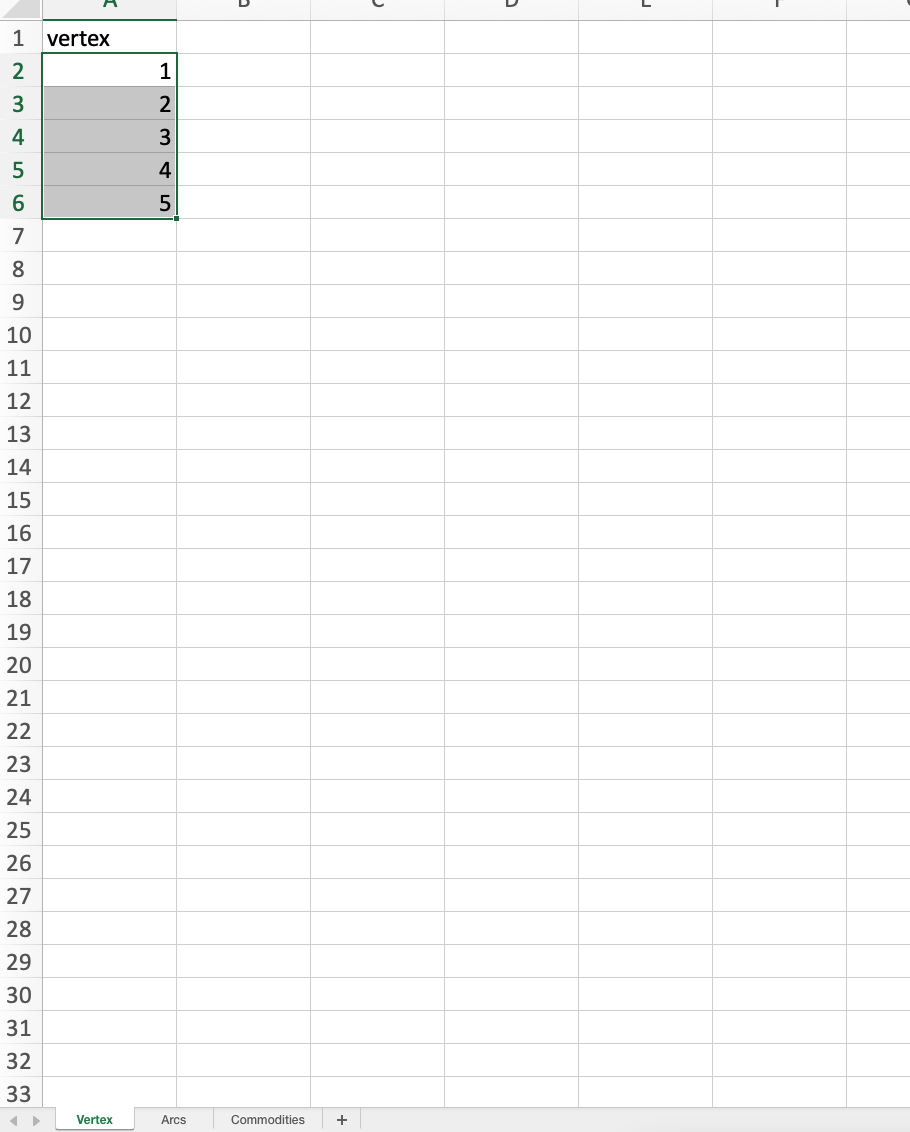
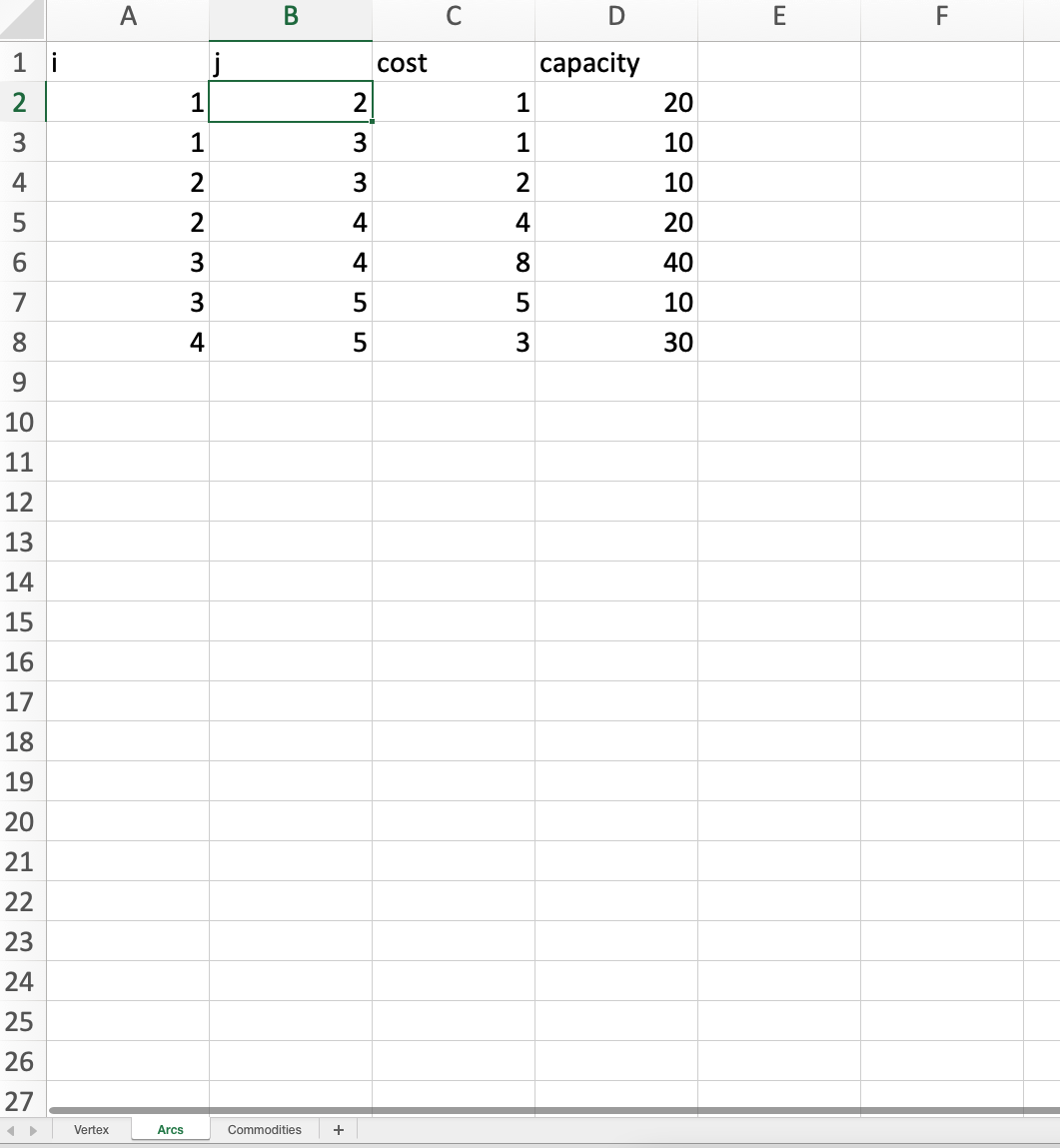
thank you for reaching out! I do make a call to the function. Let me add the whole code and screenshots of the spreadsheet. I believe the problem is the flow conservation part because if I remove that part of the code then at least the capacities print out.
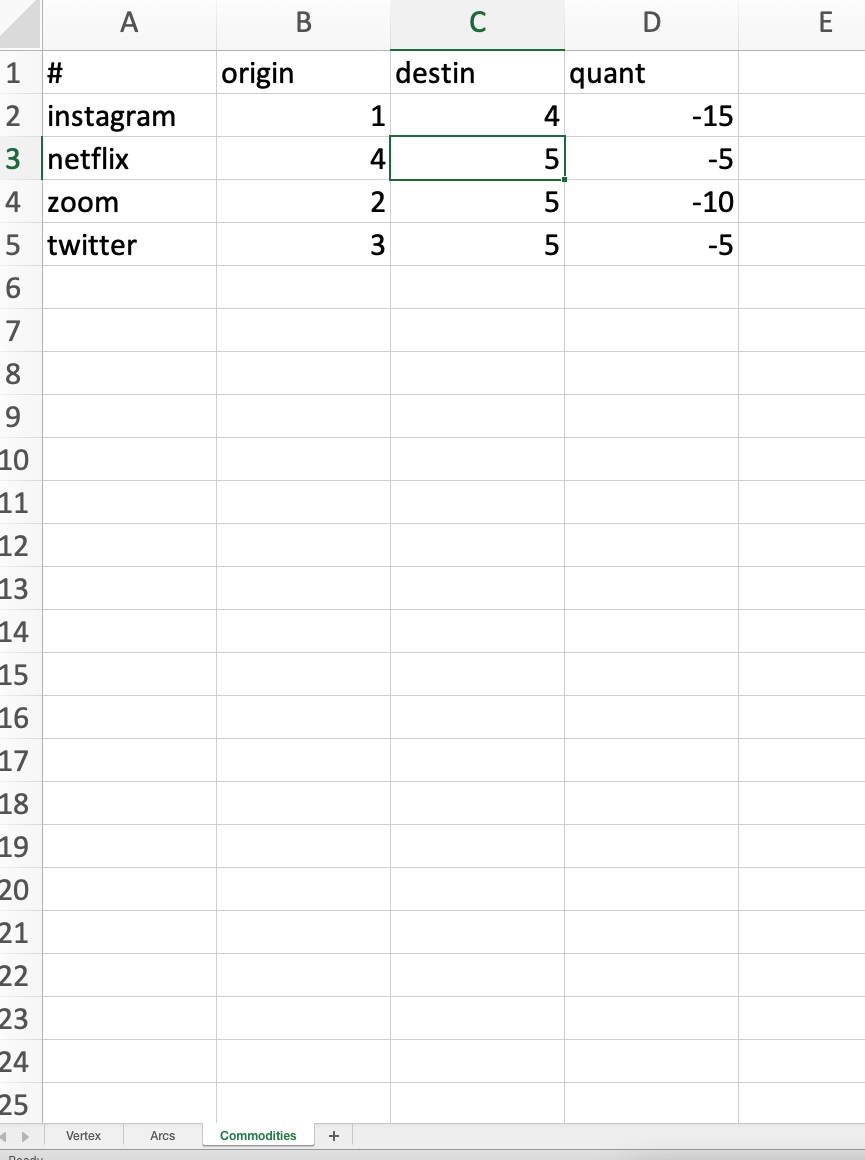
# Add a vertex to the set of vertices and the graph
import networkx as netx  # nice (di-)graph Python package
import matplotlib.pyplot as plt
import gurobipy as gp
import xlrd

vertices = []
vertices_no = 0
weight = []
graph = []
leavingnode=[]
comingnode=[]
price ={}
maxcapacity=[]
comm=[]
tran=[]
demand ={}
start=[]
cnode=[]
nodes=[]
G = netx.DiGraph()
var_names = []
var_values = []
demands={}
commo=[]
origin=[]
destination=[]
dem=[]


loc1 = ("/Users/fer/PycharmProjects/project/Input_lecct copy.xls")

wb = xlrd.open_workbook(loc1)
Vertex=wb.sheet_by_index(0)
Arcs=wb.sheet_by_index(1)
Commodities=wb.sheet_by_index(2)

################ adding vertex from excel ######################

def add_vertex(v):
    global graph
    global vertices_no
    global vertices
    if v in vertices:
        print("Vertex ", v, " already exists")
    else:
        vertices_no = vertices_no + 1
        vertices.append(v)
        if vertices_no > 1:
            for vertex in graph:
                vertex.append(0)
        temp = []
        for i in range(vertices_no):
            temp.append(0)
        graph.append(temp)

################ adding vertex from excel ######################
def add_edge(v1, v2,e):
    global graph
    global vertices_no
    global vertices
    # Check if vertex v1 is a valid vertex
    if v1 not in vertices:
        print("Vertex ", v1, " does not exist.")
    # Check if vertex v1 is a valid vertex
    elif v2 not in vertices:
        print("Vertex ", v2, " does not exist.")
    # Since this code is not restricted to a directed or
    # an undirected graph, an edge between v1 v2 does not
    # imply that an edge exists between v2 and v1
    else:
        index1 = vertices.index(v1)
        index2 = vertices.index(v2)
        graph[index1][index2] = e

################ print the pair of nodes and edgeweight ######################
def print_graph():
    global graph
    global vertices_no
    for i in range(vertices_no):
        for j in range(vertices_no):
            if graph[i][j] != 0:
                print(vertices[i], " -> ", vertices[j], \
                      " edge weight: ", graph[i][j])
                #print vertices

def draw_graph():
    global graph
    global vertices_no
    global vertices
    global weight

    for i in range(vertices_no):
        for j in range(vertices_no):
            if graph[i][j] != 0:
                weight=(graph[i][j])
                G.add_edge(vertices[i], vertices[j], weight=weight)


    epos = [(u, v) for (u, v, d) in G.edges(data=True) if d["weight"] > 0]

    pos = netx.spring_layout(G, k=150, seed=200)  # positions for all nodes - seed for reproducibility
    # nodes
    netx.draw_networkx_nodes(G, pos)
    # edges
    labels = netx.get_edge_attributes(G, 'weight')
    netx.draw_networkx_edge_labels(G, pos, edge_labels=labels)
    netx.draw_networkx_edges(G, pos, edgelist=epos, width=10,edge_color="orange")
    # labels
    netx.draw_networkx_labels(G, pos, font_size=20, font_family="sans-serif")

    ax = plt.gca()
    ax.margins(0.08)
    plt.axis("off")
    #plt.tight_layout()

    plt.show()
    #plt.savefig("graphp.png")

################ multicommodity######################

def max_flow(commodity,leavingnode,commingnode, origin,destination,cost,demandz):
    global graph
    global vertices_no
    global vertices
    global weight


    listkeyPair=[]
    for i in range(vertices_no):
        for j in range(vertices_no):
           if graph[i][j] != 0:
                listkeyPair.append((vertices[i], vertices[j]))
    print("This prints out the nodes in the pair: ",listkeyPair)

    listvalueCap=[]
    for i in range(vertices_no):
        for j in range(vertices_no):
            if  graph[i][j] != 0:
                listvalueCap.append((graph[i][j]))
    print("This prints out the capacity of the node pair: ", listvalueCap)

    pair,capacity = gp.multidict(dict(zip(listkeyPair, listvalueCap)))
    print("The dictionary after the merge of the pairs of nodes with the capacities:")
    print (capacity)


    listnodes=[]
    for i in range(vertices_no):
                listnodes.append((commodity,vertices[i]))
    print("lsit of nodes with each commodity:", listnodes)

    listactualnodes = []
    for i in range(vertices_no):
            listactualnodes.append((vertices[i]))
    print("lsit of actual nodes:", listactualnodes)


    nodes =leavingnode +commingnode
    print("list of all incoming and outgoingnodes: ", nodes)


    # Create optimization model


    m = gp.Model('netflow')

    # Create variables
    # flow = m.addVars(test,di, obj=cost, name="flow")
    flow = m.addVars(commodity, pair, obj=cost,vtype = "C", name="flow")
    # m.setObjective(flow.prod(cost), GRB.MINIMIZE)

    m.update()

    # Arc-capacity constraints
    for x, y in pair:
        m.addConstr(sum(flow[h, x, y] for h in commodity) <= capacity[x, y], "cap[%s, %s]" % (x, y))
    """
    m.addConstrs(
        (gp.quicksum(flow[h, x, y] for x, y in pair.select('*', y)) + demandz[h,o,d] ==
         gp.quicksum(flow[h, y, k] for y, k in pair.select(y, '*'))
         for h in commodity for o in origin for d in destination), "node")
    """

    for h in commodity:
        for y in nodes:
          for a in range(len(commodity)):
            if y == origin[a]:
                print("test 1")
                m.addConstrs(
                    ((gp.quicksum(flow[h, y, x] for x in leavingnode ) - gp.quicksum(
                        flow[h, x, y] for x in comingnode )) == abs(demandz[h,o,d])
                     for h in commodity for o in origin for d in destination ), name = 'Continuity(%s, %s)' % (h, y))

            elif y == destination[a]:
                print("test 2")
                m.addConstrs(
                    ((gp.quicksum(flow[h, y, x] for  x in leavingnode ) - gp.quicksum(
                        flow[h, x, y] for x in commingnode )) == demandz[h,o,d]
                     for h in commodity for o in origin for d in destination) , name= 'Continuity(%s, %s)' % (h, y))
            else:
                print("test 3")
                m.addConstrs(
                    ((gp.quicksum(flow[h, y, x] for  x in leavingnode ) - gp.quicksum(
                        flow[h, x, y] for  x in commingnode ) ) == 0
                 ), name= 'Continuity(%s, %s)' % (h, y))


    # Compute optimal solutions
    m.optimize()
    print (m.display())

    print("if model fesible it will print a 2 .", m.status)

    # Print solution

    # print solution: optimal value and optimal point
    print('Obj: %g' % m.objVal)
     #print(f"optimal value = {model.objVal:.2f}")
    for var in m.getVars():
       #print('%s %g' % (v.varName, v.x))
       if var.X > 0:
           var_names.append(str(var.varName))
           var_values.append(var.X)

#################Driver#########################
#adding the vertex sheet with all the nodes
p = 1
while True:
    try:
        v = Vertex.cell_value(p, 0)
        #adds it to list of vertices
        add_vertex(v)
        #adds it to draw graph
        nodes.append(v)
        print(nodes)
        p = p+1
    except IndexError:
        break

# adding the arcs sheet with i, j,capacity  and then matching them with a cost
i = 1
while True:
    try:

        l = Arcs.cell_value(i, 0)
        leavingnode.append(l)
        c = Arcs.cell_value(i, 1)
        comingnode.append(c)
        cap = Arcs.cell_value(i,3)
        maxcapacity.append(cap)
        add_edge(l,c,cap)
        i = i+1
    except IndexError:
        break

z = 1
while True:
    try:
        for leave  in leavingnode:
           c = Arcs.cell_value(z, 1)
           price[leave,c]=Arcs.cell_value(z,2)
           print("cost:", price[leave,c])
           z = z+1
    except IndexError:
        break


# adding the commodities sheet with #, origin, destination and quantity
i = 1
while True:
    try:
        item= Commodities.cell_value(i,0)
        commo.append(item)
        ori = Commodities.cell_value(i, 1)
        origin.append(ori)
        dest = Commodities.cell_value(i, 2)
        destination.append(dest)
        i = i+1
    except IndexError:
        break

a = 1
while True:
    try:
        for it in commo:
           ori = Commodities.cell_value(a, 1)
           dest = Commodities.cell_value(a, 2)
           dem.append(demands)
           demands[it,ori,dest]=Commodities.cell_value(a,3)
           print("Demands:", demands[it,ori,dest])
           a = a+1
    except IndexError:
        break

print_graph()
print("Internal representation: ", graph)
#draw_graph()

print("END:")
print("commo",commo)
print("origin:",origin)
print('destination',destination)

print("leaving", leavingnode)
print('coming', comingnode)

max_flow(commo,leavingnode,comingnode, origin,destination, price, demands)
0 -
-
-
Hi Fernanda,
The error is that you access \(\texttt{flow[instagram, 1.0, 1.0]}\) which is not present.
for y in nodes:
  for a in range(len(commodity)):
    if y == origin[a]:
      print("test 1")
        m.addConstrs(
        ((gp.quicksum(flow[h, y, x] for x in leavingnode ) - gp.quicksum(
         flow[h, x, y] for x in commingnode )) == abs(demandz[h,o,d])
         for h in commodity for o in origin for d in destination ), name = 'Continuity(%s, %s)' % (h, y))
You iterate \(\texttt{y}\) over all \(\texttt{nodes}\), so in the first iteration \(\texttt{y=1.0}\). The list \(\texttt{leavingnode}\) is
[1.0, 1.0, 2.0, 2.0, 3.0, 3.0, 4.0]
Thus, you try to access \(\texttt{flow[instagram, 1.0, 1.0]}\), which is not present. You should rather iterate over all arcs (\(\texttt{pair}\) in your code).
You can print the lists \(\texttt{nodes, commingnode, leavingnode}\) to check which variable is iterated over which values.
Moreover, there is a typo \(\texttt{comingnode}\) should read \(\texttt{commingnode}\) in line 193.
Best regards,
Jaromił0 -
-
Hello Jaromil,
thanks again so I changed it slightly but now the issue is the syntax for m.Constrs or m.Constr. When I do m.Constrs , I get 3 printed results. When I do m.Constr, we get one printed result and the error says that its missing a constraint index. Not sure which one to use because they both seem to be giving an error.
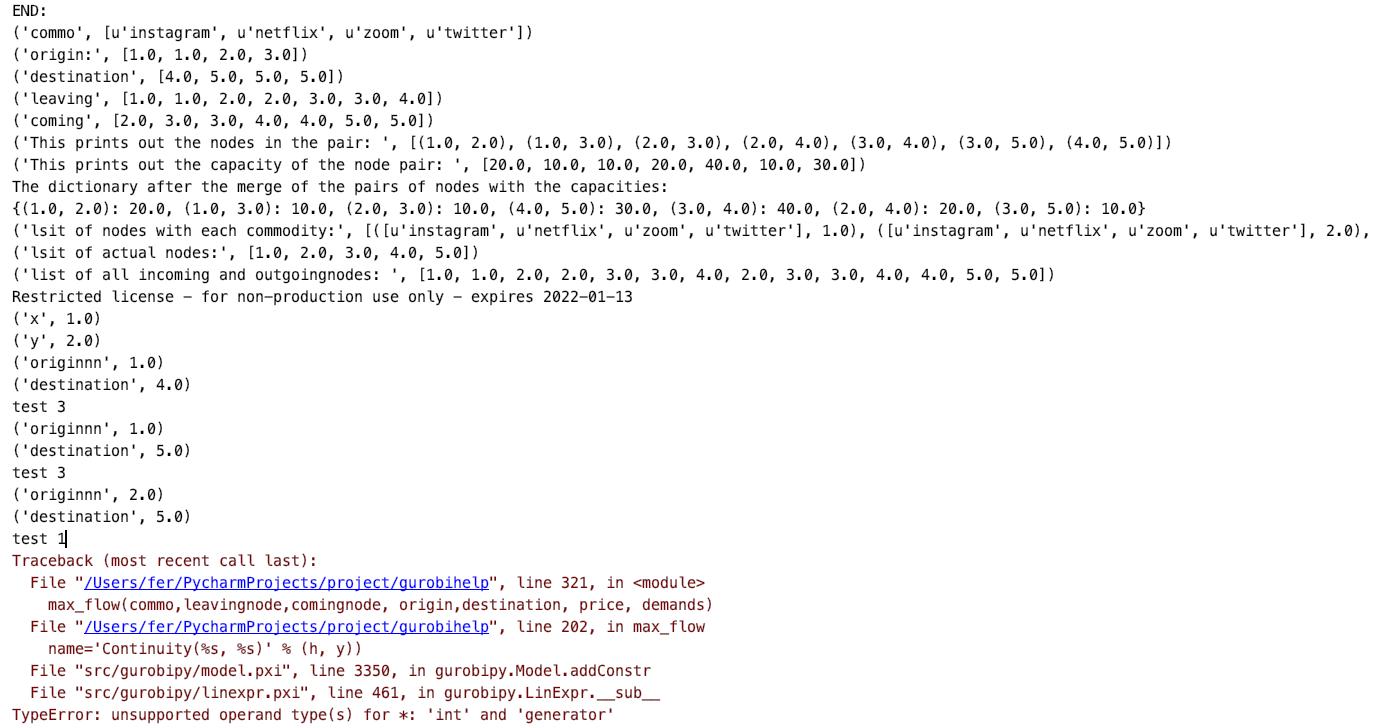
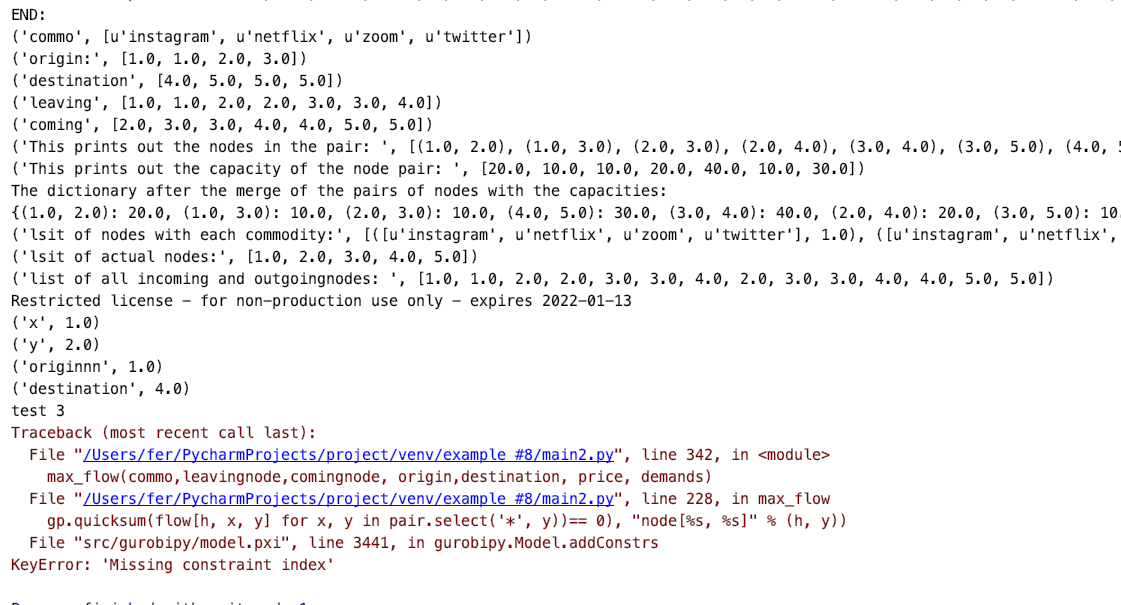 0
0 -
-
-
Hi Fernanda,
addConstrs needs a generator expression to construct multiple constraints at once.
Thus, the code
 m.addConstrs(((gp.quicksum(flow[h, y, x] for  x in leavingnode ) - gp.quicksum(
               flow[h, x, y] for  x in commingnode ) ) == 0),
               name= 'Continuity(%s, %s)' % (h, y))
is incorrect, because you don't generate multiple constraints but rather just one. So in this case, you should use addConstr. The above should read
 m.addConstr(((gp.quicksum(flow[h, y, x] for x in leavingnode ) - gp.quicksum(
               flow[h, x, y] for x in commingnode ) ) == 0),
               name= 'Continuity(%s, %s)' % (h, y))
Please note that the code above is using your old code. Could you provide the changes you made to avoid the key error? Are you now able to run your code successfully?
Best regards,
Jaromił0 -
-
Hello again,
yes so if we also change it to addConstr, it still gives us an error (screenshot below).
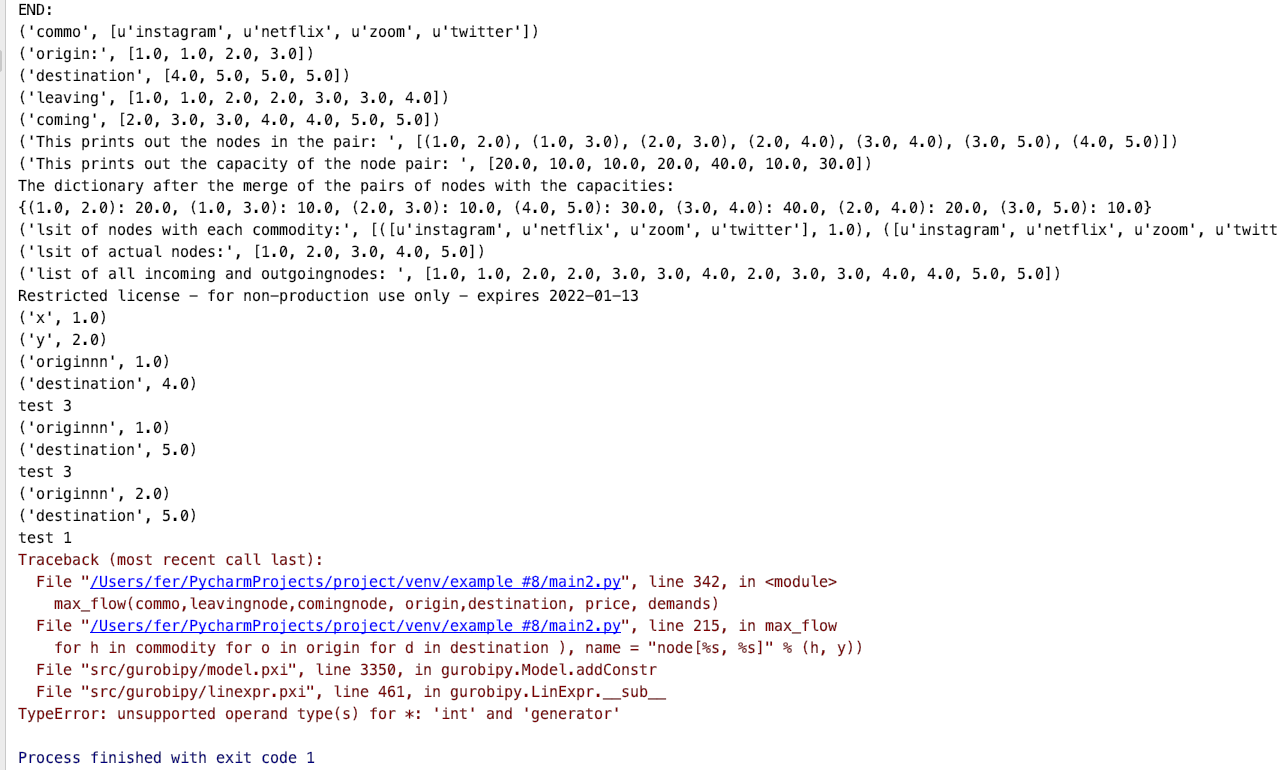 We provided the most recent code below as well.
 import networkx as netx
import matplotlib.pyplot as plt
import gurobipy as gp
import xlrd
vertices = []
vertices_no = 0
weight = []
graph = []
leavingnode=[]
comingnode=[]
price ={}
maxcapacity=[]
comm=[]
tran=[]
demand ={}
start=[]
cnode=[]
nodes=[]
G = netx.DiGraph()
var_names = []
var_values = []
demands={}
commo=[]
origin=[]
destination=[]
dem=[]
loc1 = ("/Users/fer/PycharmProjects/project/Input_lecct copy.xls")
wb = xlrd.open_workbook(loc1)
Vertex=wb.sheet_by_index(0)
Arcs=wb.sheet_by_index(1)
Commodities=wb.sheet_by_index(2)
################ adding vertex from excel ######################
def add_vertex(v):
global graph
global vertices_no
global vertices
if v in vertices:
print("Vertex ", v, " already exists")
else:
vertices_no = vertices_no + 1
vertices.append(v)
if vertices_no > 1:
for vertex in graph:
vertex.append(0)
temp = []
for i in range(vertices_no):
temp.append(0)
graph.append(temp)
################ adding vertex from excel ######################
def add_edge(v1, v2,e):
global graph
global vertices_no
global vertices
# Check if vertex v1 is a valid vertex
if v1 not in vertices:
print("Vertex ", v1, " does not exist.")
# Check if vertex v1 is a valid vertex
elif v2 not in vertices:
print("Vertex ", v2, " does not exist.")
# Since this code is not restricted to a directed or
# an undirected graph, an edge between v1 v2 does not
# imply that an edge exists between v2 and v1
else:
index1 = vertices.index(v1)
index2 = vertices.index(v2)
graph[index1][index2] = e
################ print the pair of nodes and edgeweight ######################
def print_graph():
global graph
global vertices_no
for i in range(vertices_no):
for j in range(vertices_no):
if graph[i][j] != 0:
print(vertices[i], " -> ", vertices[j], \
" edge weight: ", graph[i][j])
#print vertices
def draw_graph():
global graph
global vertices_no
global vertices
global weight
for i in range(vertices_no):
for j in range(vertices_no):
if graph[i][j] != 0:
weight=(graph[i][j])
G.add_edge(vertices[i], vertices[j], weight=weight)
epos = [(u, v) for (u, v, d) in G.edges(data=True) if d["weight"] > 0]
pos = netx.spring_layout(G, k=150, seed=200) # positions for all nodes - seed for reproducibility
# nodes
netx.draw_networkx_nodes(G, pos)
# edges
labels = netx.get_edge_attributes(G, 'weight')
netx.draw_networkx_edge_labels(G, pos, edge_labels=labels)
netx.draw_networkx_edges(G, pos, edgelist=epos, width=10,edge_color="orange")
# labels
netx.draw_networkx_labels(G, pos, font_size=20, font_family="sans-serif")
ax = plt.gca()
ax.margins(0.08)
plt.axis("off")
#plt.tight_layout()
plt.show()
#plt.savefig("graphp.png")
################ multicommodity######################
def max_flow(commodity,leavingnode,commingnode, origin,destination,cost,demandz):
global graph
global vertices_no
global vertices
global weight
listkeyPair=[]
for i in range(vertices_no):
for j in range(vertices_no):
if graph[i][j] != 0:
listkeyPair.append((vertices[i], vertices[j]))
print("This prints out the nodes in the pair: ",listkeyPair)
listvalueCap=[]
for i in range(vertices_no):
for j in range(vertices_no):
if graph[i][j] != 0:
listvalueCap.append((graph[i][j]))
print("This prints out the capacity of the node pair: ", listvalueCap)
pair,capacity = gp.multidict(dict(zip(listkeyPair, listvalueCap)))
print("The dictionary after the merge of the pairs of nodes with the capacities:")
print (capacity)
listnodes=[]
for i in range(vertices_no):
listnodes.append((commodity,vertices[i]))
print("lsit of nodes with each commodity:", listnodes)
listactualnodes = []
for i in range(vertices_no):
listactualnodes.append((vertices[i]))
print("lsit of actual nodes:", listactualnodes)
nodes =leavingnode +commingnode
print("list of all incoming and outgoingnodes: ", nodes)
# Create optimization model
m = gp.Model('netflow')
# Create variables
# flow = m.addVars(test,di, obj=cost, name="flow")
flow = m.addVars(commodity, pair, obj=cost,vtype = "C", name="flow")
# m.setObjective(flow.prod(cost), GRB.MINIMIZE)
m.update()
# Arc-capacity constraints
for x, y in pair:
m.addConstr(sum(flow[h, x, y] for h in commodity) <= capacity[x, y], "cap[%s, %s]" % (x, y))
for h in commodity:
for x, y in pair:
print("x", x)
print("y", y)
for a in range(len(commodity)):
print ("originnn", origin[a])
print ("destination", destination[a])
if y == origin[a]:
print("test 1")
m.addConstr(
gp.quicksum(flow[h, y, k] for y, k in pair.select(y, '*')) -
gp.quicksum(flow[h, x, y] for x, y in pair.select('*', y)), '=', (abs(demandz[h, o, d])
for h in commodity for o in
origin for d in destination),
name="node[%s, %s]" % (h, y))
elif y == destination[a]:
print("test 2")
m.addConstr(
gp.quicksum(flow[h, y, k] for y, k in pair.select(y, '*')) -
gp.quicksum(flow[h, x, y] for x, y in pair.select('*', y)), '=', (demandz[h, o, d]
for h in commodity for o in
origin for d in destination),
name="node[%s, %s]" % (h, y))
else:
print("test 3")
m.addConstr(
gp.quicksum(flow[h, y, k] for y, k in pair.select(y, '*')) -
gp.quicksum(flow[h, x, y] for x, y in pair.select('*', y)), '=', 0,
name="node[%s, %s]" % (h, y))
# Compute optimal solutions
m.optimize()
print (m.display())
print("if model fesible it will print a 2 .", m.status)
# Print solution
# print solution: optimal value and optimal point
print('Obj: %g' % m.objVal)
#print(f"optimal value = {model.objVal:.2f}")
for var in m.getVars():
#print('%s %g' % (v.varName, v.x))
if var.X > 0:
var_names.append(str(var.varName))
var_values.append(var.X)
#################Driver#########################
#adding the vertex sheet with all the nodes
p = 1
while True:
try:
v = Vertex.cell_value(p, 0)
#adds it to list of vertices
add_vertex(v)
#adds it to draw graph
nodes.append(v)
print(nodes)
p = p+1
except IndexError:
break
# adding the arcs sheet with i, j,capacity and then matching them with a cost
i = 1
while True:
try:
l = Arcs.cell_value(i, 0)
leavingnode.append(l)
c = Arcs.cell_value(i, 1)
comingnode.append(c)
cap = Arcs.cell_value(i,3)
maxcapacity.append(cap)
add_edge(l,c,cap)
i = i+1
except IndexError:
break
z = 1
while True:
try:
for leave in leavingnode:
c = Arcs.cell_value(z, 1)
price[leave,c]=Arcs.cell_value(z,2)
print("cost:", price[leave,c])
z = z+1
except IndexError:
break
# adding the commodities sheet with #, origin, destination and quantity
i = 1
while True:
try:
item= Commodities.cell_value(i,0)
commo.append(item)
ori = Commodities.cell_value(i, 1)
origin.append(ori)
dest = Commodities.cell_value(i, 2)
destination.append(dest)
i = i+1
except IndexError:
break
a = 1
while True:
try:
for it in commo:
ori = Commodities.cell_value(a, 1)
dest = Commodities.cell_value(a, 2)
dem.append(demands)
demands[it,ori,dest]=Commodities.cell_value(a,3)
print("Demands:", demands[it,ori,dest])
a = a+1
except IndexError:
break
print_graph()
print("Internal representation: ", graph)
#draw_graph()
print("END:")
print("commo",commo)
print("origin:",origin)
print('destination',destination)
print("leaving", leavingnode)
print('coming', comingnode)
max_flow(commo,leavingnode,comingnode, origin,destination, price, demands)0 -
-
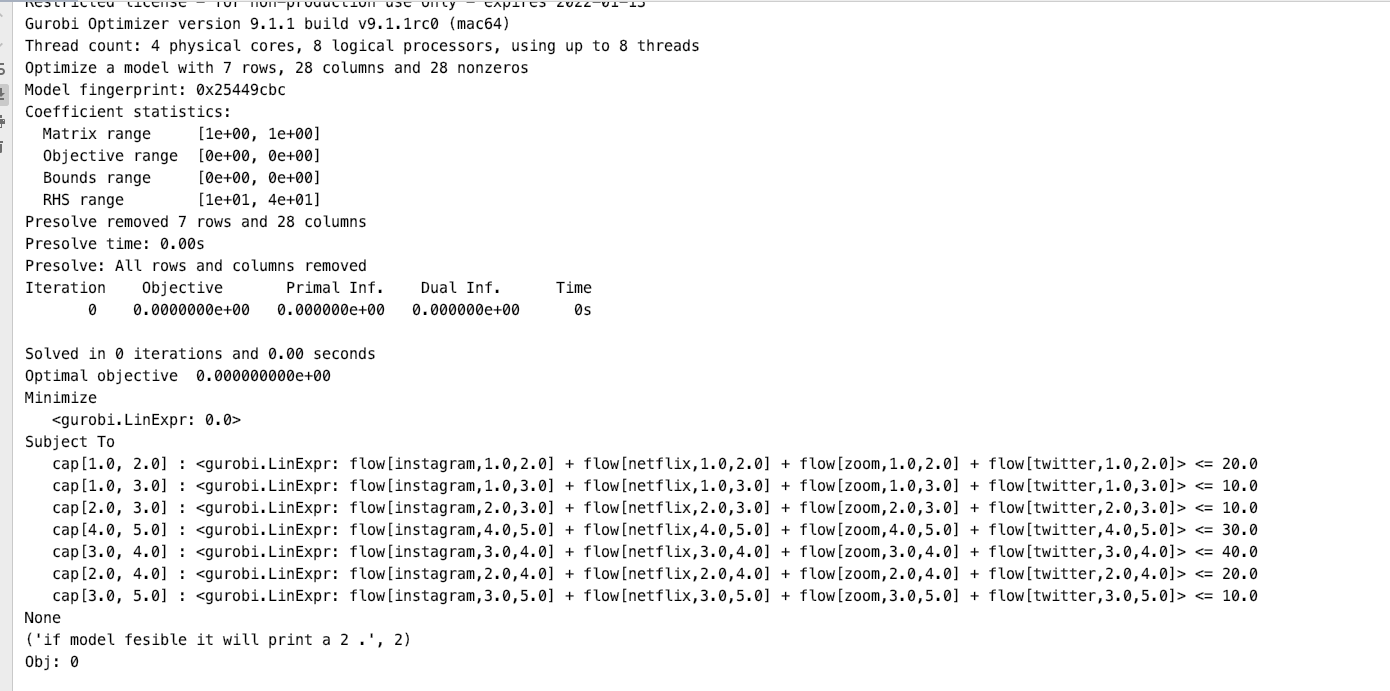
Hello again,
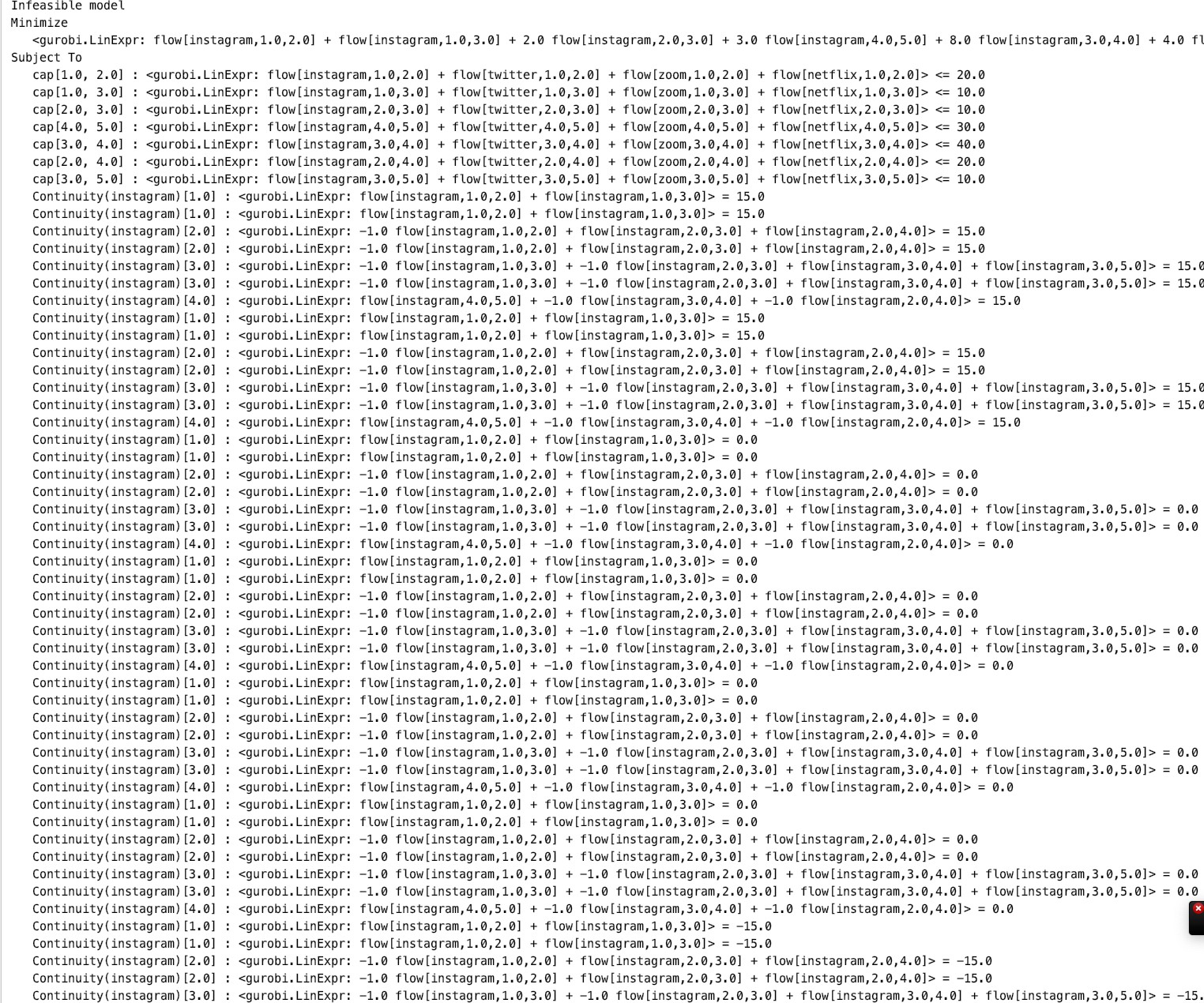
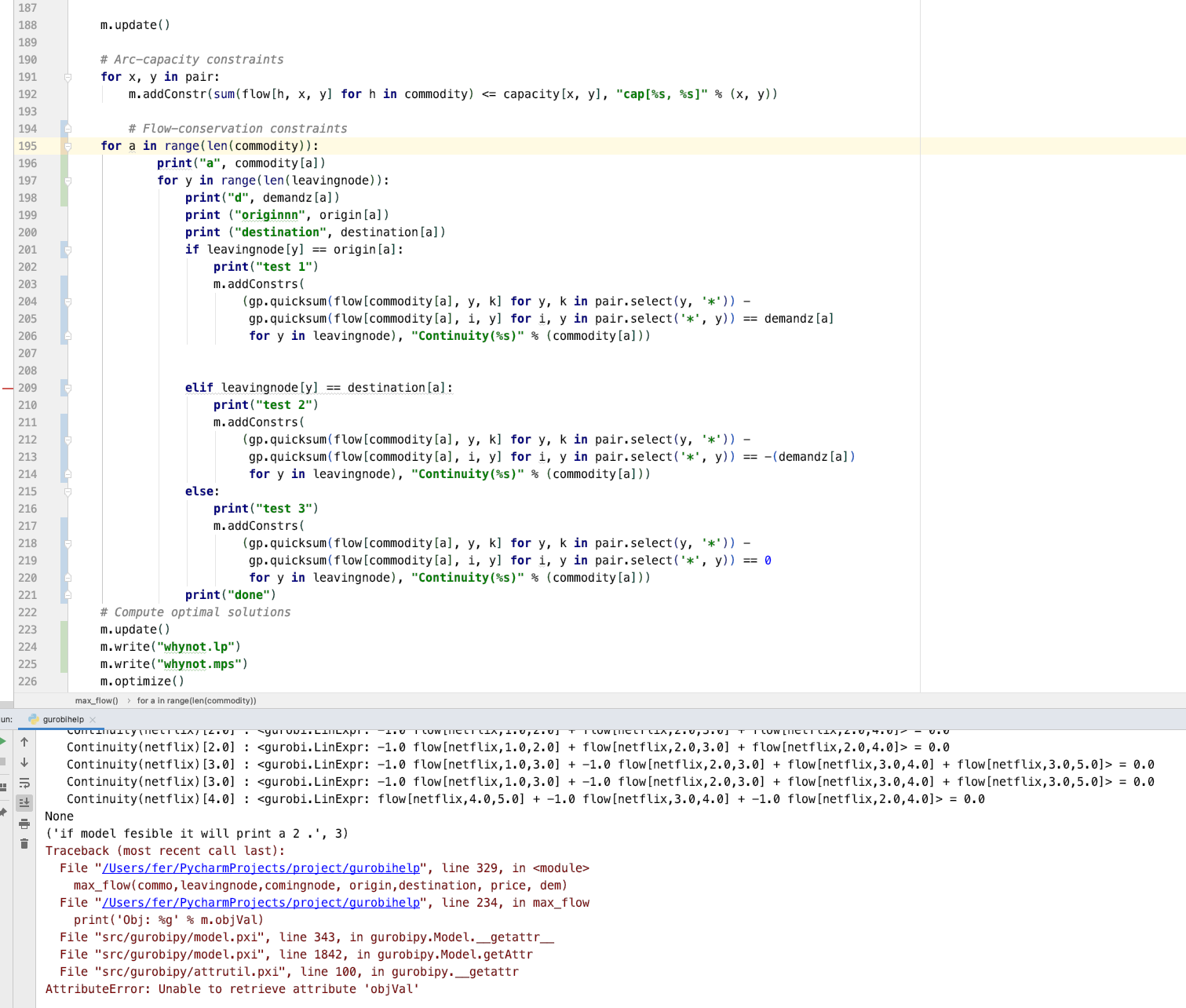
I still haven't heard back, but it finally prints out results but now the problem is that it repeats the same set of vertices for each commodity about 7 times. Here are some screenshots. please let me know what the issue is.
 0
0 -
-
-
Hi Fernanda,
Sorry for getting back to you, I was out for the last weeks.
The issue may be caused by using \(\texttt{y}\) as an iterator multiple times in your \(\texttt{for}\)-loops.
\(\texttt{y}\) is used in
for y in range(len(leavingnode)):
and then again in multiple contexts in the
m.addConstrs(... for y, k ... for y in leavingnode ...)
terms.
Please also note that the model status you get in your last screenshot is 3 which means \(\texttt{INFEASIBLE}\). Thus, you cannot access the ObjVal attribute. You could use the write() function to write an LP file and analyze by hand whether the model looks as expected
m.write("myLP.lp")Best regards,
Jaromił0 -
Post is closed for comments.
Comments
9 comments