Difference between nested quicksum and several quicksums
OngoingHello,
I have a question about optimization effiency. I implement gurobi optimizer in Python. I wonder if model with nested quicksum would performs better that with parellel quicksums. I provide an example to decribe my question. Given my objective function is

would it better to construct it as

The corresponding codes are
model.setObjective(
    quicksum(P[i] * x[i] for i in I) -
    quicksum(C[i, j] * y[i, j] for i in I for j in J),
    GRB.MAXIMUM
)
model.setObjective(
    quicksum(
        P[i] * x[i] - quicksum(
            C[i, j] * y[i, j]
            for j in J
        )
        for i in I
    ),
    GRB.MAXIMUM
)
I have tried to analize the difference between the above two methods. The total number of iterations may be lower in the latter one. While I doubt if they are the same after processed and reconstructed by Gurobi optimizer. Besides, the above instance is simplified. I consider the complexity may impact the advatages or disadvatages in each way. Would the advantages keep consistant even in constraints?
I have another problem is regarding to the usage of quicksum. May I assign the quicksum value to a variable and use the variable in both addConstrs and setObjectives?
The code block below is a simple example. x is decision variables. I and P are static parameters.
I = ["1", "2", "3"]
P = {"1": 2, "2": 2, "3": 4}

model = Model()
x = model.addVars(I, vtype=GRB.BINARY)
tmp_var = quicksum(P[i] * x[i] for i in I)

model.addConstr(tmp_var < 5)
model.setObjective(tmp_var, GRB.MAXIMUM)
I wonder whether creating a variable reference to the quicksum object helps in efficiency.
Thanks a lot! I really appreciate your help.
-
Official comment

-
Gurobi Staff
This post is more than three years old. Some information may not be up to date. For current information, please check the Gurobi Documentation or Knowledge Base. If you need more help, please create a new post in the community forum, or try Gurobot, our chatbot interface offering instant, expert-level support. -
-

-
Hi Trista,
You can check your thesis by writing a small script and checking the times
import gurobipy as gp
from gurobipy import GRB
import numpy as np
import time

I = 1000
J = 1000
P = np.random.rand(I)
C = np.random.rand(I,J)

m = gp.Model()

x = m.addVars(I)
y = m.addVars(I,J)

start = time.time()
m.setObjective(
    gp.quicksum(P[i] * x[i] for i in range(I)) -
    gp.quicksum(C[i, j] * y[i, j] for i in range(I) for j in range(J))
)
time_needed = time.time() - start
print("Time needed for 1st version: %f"%(time_needed))

start = time.time()
m.setObjective(
    gp.quicksum(
        P[i] * x[i] - gp.quicksum(
            C[i, j] * y[i, j]
            for j in range(J)
        )
        for i in range(I)
    )
)
time_needed = time.time() - start
print("Time needed for 2nd version: %f"%(time_needed))
You will notice that there is no much difference between the two versions. However, you can significantly improve model building speed with the following version
start = time.time()
lexpr = gp.LinExpr(0)
for i in range(I):
    lexpr.add(x[i], P[i])
    for j in range(J):
        lexpr.add(y[i,j], -C[i,j])

m.setObjective(lexpr)
time_needed = time.time() - start
print("Time needed for 3rd version: %f"%(time_needed))
You can read more on efficient model building in How do I improve the time to build my model?
Would the advantages keep consistant even in constraints?
Yes, if the constraints are build in a similar way.
May I assign the
quicksumvalue to a variable and use the variable in bothaddConstrsandsetObjectives?Yes. The quicksum function returns an expression object which can be reused in other expression objects.
Note that Gurobi does not support strict inequalities. Thus
model.addConstr(tmp_var < 5)is not available in Gurobi, only \(\leq\). Moreover, it should be
model.setObjective(tmp_var, GRB.MAXIMIZE)
Best regards,
Jaromił0 -
-

Hello Jaromił,
Thanks for your promt reply. I look into the links you provided and did some search concerning
LinExpr,quicksum,tupledict.sum,add,addTerms.I tried different writing ways to solve the problem in network.py. Accoring to the same instance in it, I derive some observations.
addConstrwith for loop is faster thanaddConstrs.quicksumwith for loop is faster than that withtupledict.selectortupledict.sum. I doubt that these observations are general enough and prove some universal prospositions.However, I encountered that
LinExprmay not help in effiency in this instance. I wonder what is the factor to makeLinExprdominant. Is it the nested structure of the expression to bring the advantage? Besides, one math equation with some summation may be written inLinExprwithadd,addTerms,quicksumor+. Which one would be the fastest? In another case, if the right-hand-side equation is only a product of two objects, is it still faster to useLinExprinstead of*ortupledict.prod? Is it more ideal to construct a expression with equality or inequality sign to form a constraint or make the LHS and RHS respectively and use them inaddConstr?I truely appreciate your kind response.
Best regards,
Trista
0 -
-
-
Hi Trista,
Gurobi methods should be more efficient than the methods built into the data structures. Thus, it makes sense that quicksum is faster than .select or .sum. It is also true that addConstr in a for-loop can be slightly faster than addConstrs in some cases.
Using LinExpr with addTerms should be fastest followed by add. However, there quicksum can outperform those in some cases. In general, the difference in speed between the 3 should not be too big. However, the difference in speed is significant if you would construct your linear expressions via the += and *= operators.
In another case, if the right-hand-side equation is only a product of two objects, is it still faster to use
LinExprinstead of*ortupledict.prod?If the number of objects is small, then there should be no significant difference.
Is it more ideal to construct a expression with equality or inequality sign to form a constraint or make the LHS and RHS respectively and use them in
addConstr?There should be no significant difference between those 2 options. I would recommend using the version which you find to be easier to read/understand.
In general, if model construction speed is crucial for your application, I would test different alternatives to find the best performing one for your particular model.
Best regards,
Jaromił0 -
-
Hi
Thanks for your promt reply. I have another relative question. The screenshot below is captured from the official website document.
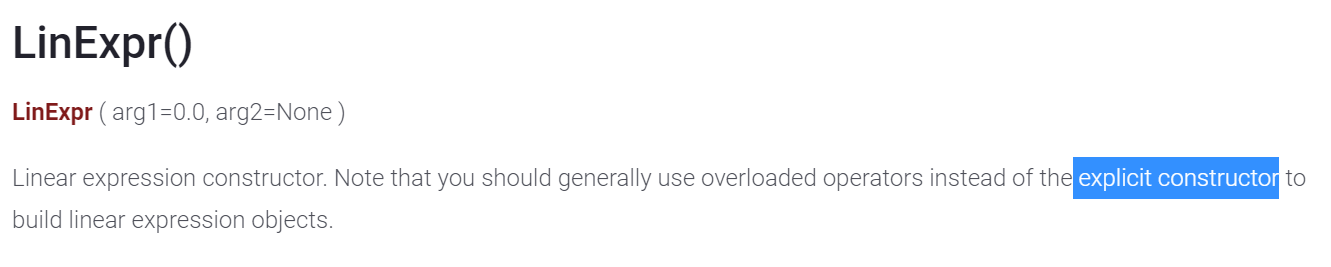 Could you please provide some examples of explicit constructors? I truely appreciate your time and help.
Best regards,
Trista
0 -
-
-
Hi Trista,
What the documentation means is
For linear expressions of moderate size (only a few terms) and for the ease of usage, you should generally use overloaded operators instead of the explicit constructor to build linear expression objects.
An example of an explicit constructor usage would be
X = []
coeffs = []
for i in range(1,1001):
  X.append(m.addVar( name="X%d"%(i)))
  coeffs.append(i)

expr = gp.LinExpr(coeffs, X) # LinExpr constructor taking 2 lists
m.addConstr(expr <= 5)
Best regards,
Jaromił0 -
-

I was trying to imitate this snipped in my code
lexpr = gp.LinExpr(0)
for i in range(I):
    lexpr.add(x[i], P[i])
    for j in range(J):
        lexpr.add(y[i,j], -C[i,j])

m.setObjective(lexpr)
y = m.addVars(frequencies, vtype=GRB.BINARY, name="y") #frequency "i" purchased {1 = yes, 0 = no }
x = m.addVars(frequencies,cities, vtype=GRB.BINARY, name="x") # frequency "i" is used in city "J" {1 = used, 0 = not used}lexpr = gp.LinExpr(0)
for i in frequencies:
lexpr.add(y[i],-500000)
for j in cities:
lexpr.add(c[i],x[i,j])m.setObjective(lexpr,GRB.MAXIMIZE)
However, I am getting errors on the line concerning the inner FOR loop. This is the error message:
Could you advise what could be the cause of it?
TypeError                                 Traceback (most recent call last)
~\AppData\Local\Temp/ipykernel_23848/3267894265.py in <module>
      5     lexpr.add(y[i],-500000)
      6     for j in cities:
----> 7         lexpr.add(c[i],x[i,j])
      8
      9 m.setObjective(lexpr,GRB.MAXIMIZE)

src\gurobipy\linexpr.pxi in gurobipy.LinExpr.add()

src\gurobipy\linexpr.pxi in gurobipy.LinExpr.addConstant()

TypeError: float() argument must be a string or a number, not 'gurobipy.LinExpr'
0 -
Post is closed for comments.
Comments
7 comments