Adding conditions to quicksum
回答済みHello, I'm trying to build this equation using "quicksum", but it never works. How should I fix it?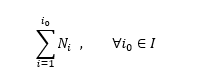
I=[1,2,3,4,5]
model.addConstrs((gp.quicksum(N[i] for i in range(1,i0+1))<=10 for i0 in I),name="Constr1")
-
正式なコメント

-
Gurobi Staff
This post is more than three years old. Some information may not be up to date. For current information, please check the Gurobi Documentation or Knowledge Base. If you need more help, please create a new post in the community forum, or try Gurobot, our chatbot interface offering instant, expert-level support. -
-

another question, because I previously attempted to write this way by:
model.addConstrs((N[k]>=F[k]-F[k-1] for i in range(k-1,k) for k in I),name="Constr2")
and error is
name 'k' is not defined
Are there other possible ways of writing this?
0 -
-

-
Could you please provide a complete minimal reproducible example where you also define N, I, F, and the show error you see?
0 -
-
I seem to have solved this problem
for example:
I_1 = [1,2,3,4,5]
I = [2,3,4,5]
N = model.addVars(I, vtype=GRB.BINARY, name="N")
F = model.addVars(I_1, vtype=GRB.BINARY, name="F")

model.addConstrs(N[i]>=F[i]-F[i-1] for i in I)
model.addConstrs(N[i]>=F[i-1]-F[i] for i in I)
model.addConstrs(N[i]<=F[i-1]+F[i] for i in I)
model.addConstrs(N[i]<=2-F[i-1]-F[i] for i in I)
I don't know why before I came across this error(name 'k' is not defined) anyway, thanks.
and the first question, I have solved with for-loops:
for i0 in I:
  model.addConstrs(gp.quicksum(N[i] for i in range(1,i0+1))<=10)
maybe you have other better way to write this in one sentence?
0 -
-
-
There are two issues with your for-loop
for i0 in I:
  model.addConstrs(gp.quicksum(N[i] for i in range(1,i0+1))<=10)
You define \(N\) over \(I = \{2,3,4,5\}\), but in the \(\texttt{quicksum}\), you iterate over \(\texttt{range(1,i0+1)}\) which holds the index \(1\). For example, when \(i_0 = 2\), then \(i\) iterates over the list \([1,2]\). However, \(N_1\) is not available, only \(N_2, N_3,N_4,N_5\). You could define \(N\) over \(I_1\) to avoid this issue
N = model.addVars(I_1, vtype=GRB.BINARY, name="N")
Moreover, you use the addConstrs method, which takes a list of constraints as input. However, you are already adding your constraints via the for-loop. Thus, you should use the addConstr method
for i0 in I:
  model.addConstr(gp.quicksum(N[i] for i in range(1,i0+1))<=10)
Alternatively, you can use the addConstrs method and move the for-loop into constraint construction
model.addConstrs( (gp.quicksum(N[i] for i in range(1,i0+1))<=10) for i0 in I)
Best regards,
Jaromił1 -
投稿コメントは受け付けていません。
コメント
5件のコメント