If Constraint
AnsweredHelloo,
I have 2 binary variables h[i,j,t] and u[i,j,t] and I need to express this constraint in my model:
if for a given i : u[i,j,t]=1 then for all other i, h[i,j,t]=0,
the solution i found is :
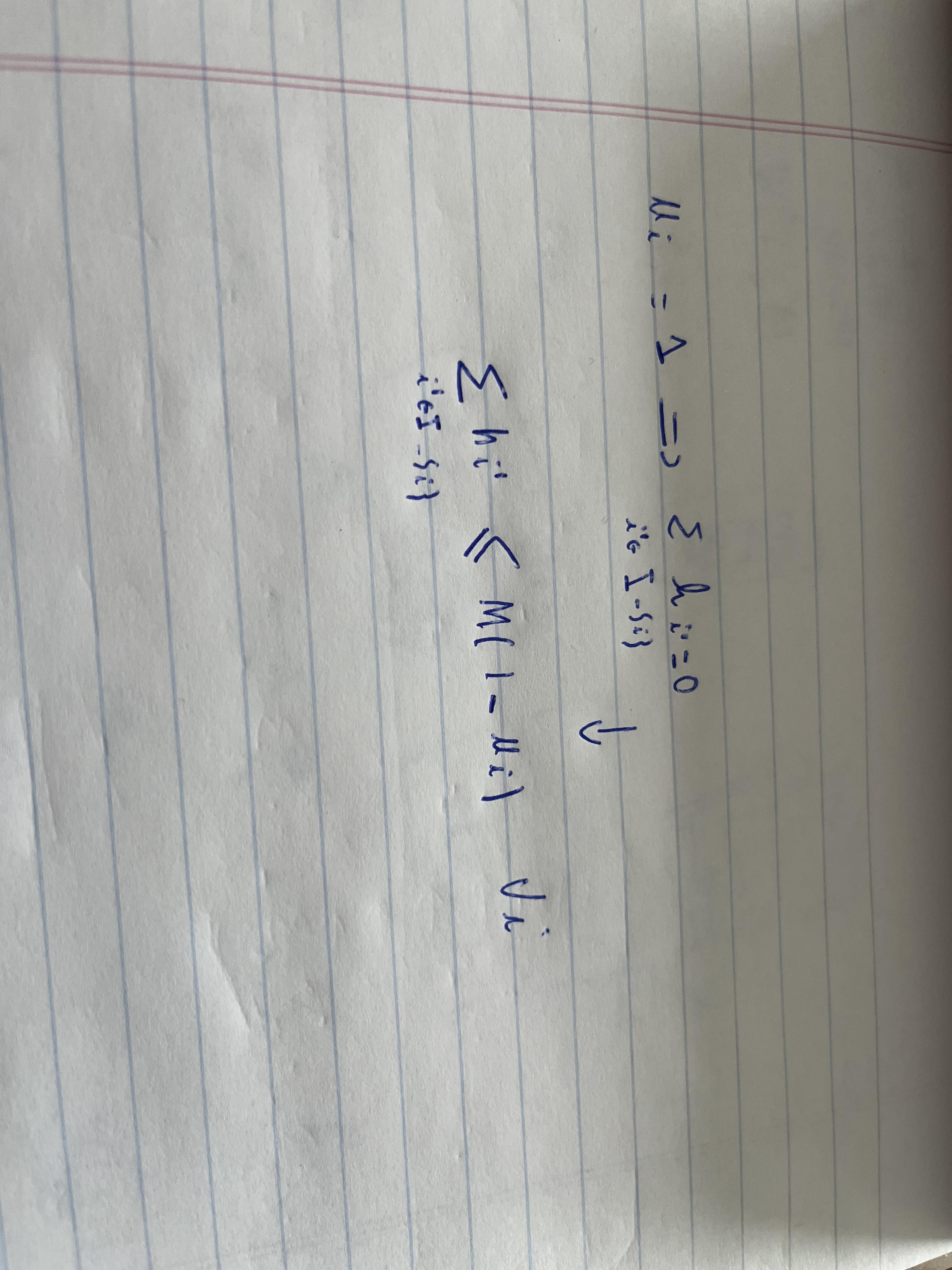
But i dont know how to express it in Gurobipy,
thank you,
-
Official comment

-
Gurobi Staff
In addition, please see our Knowledge Base article How do I model conditional statements in Gurobi?
-
-
Official comment

-
This post is more than two years old. Some information may not be up to date. For current information, please check the Gurobi Documentation or Knowledge Base. If you need more help, please create a new post in the community forum, or try Gurobot, our chatbot interface offering instant, expert-level support. -
-
-
Hi Rayan,
Your solution is correct. You can model this as follows:
m.addConstrs( sum( h[k,j,t] for k in I if k != i) <= M *( 1- u[i,j,t] ) for i in I for j in J for t in T )
Please choose the smallest possible value of M carefully. One value can be the sum of the upper bounds on the h variables.
Alternatively, you can add an indicator constraint, which does not require you to choose the value of M :
m.addConstrs( (u[i,j,t] ==1) >> (sum( h[k,j,t] for k in I if k != i) == 0 ) for i in I for j in J for t in T )
Best regards,Simran0 -
-

It perfectly worked !
Thanks a lot !!
0 -
-
Hello Simrane,
I want to express the same constraint, but this time i have 4 index for my 2 variables :
h[i,c,j,t] and u[i,c,j,t]
if for a given i and c : u[i,c,j,t]=1 then for all other i, and c : h[i,c,j,t]=0,
I tried this formulation, but it doesn't work :
model.addConstrs( (u[i,c,j,t] ==1) >> (gp.quicksum( h[k,d,j,t] for k in range(I) if k != i for d in range(C) if d != c) == 0 ) for i in range(I) for j in range(J) for t in range(T) for c in range(C))
0 -
-
-
Hi Rayan,
Your implementation should work fine if you want to add the constraint:
u[i,c,j,t]=1 implies h[k,d,j,t] = 0 for all h variables where k != i and d !=c.
However, if you want to add the constraint:
u[i,c,j,t]=1 implies h[k,d,j,t] = 0 for all h variables where k != i or d !=c,
you will need to modify your indicator constraint as follows:
m.addConstrs( (u[i,c,j,t] ==1) >> (gp.quicksum( h[k,d,j,t] for k in range(I) for d in range(C) if ( k != i or d != c) ) == 0 ) for i in range(I) for j in range(J) for t in range(T) for c in range(C))
Best regards,
Simran
0 -
Post is closed for comments.
Comments
6 comments