Limiting the number of activated binary variables
AnsweredHello everyone,
I am working on the problem of topology optimisation in power grids. In this type of model there are many IF constraints which are modelled using the Big-M method. It is possible to limit the number of topology actions with an inequality constraint, e.g. sum(x_i)<= Nmax x_i \in {0,1}. As expected, the larger the Nmax, the larger the search space and the longer it takes to solve. However, this does not mean that a better solution will be found.
In a minimal example model, I have the following bestBound and Incumbent performance for an increasing number of Nmax from 1 to 5. The values are given in % of the initial incumbent, as I provide a good MIP start.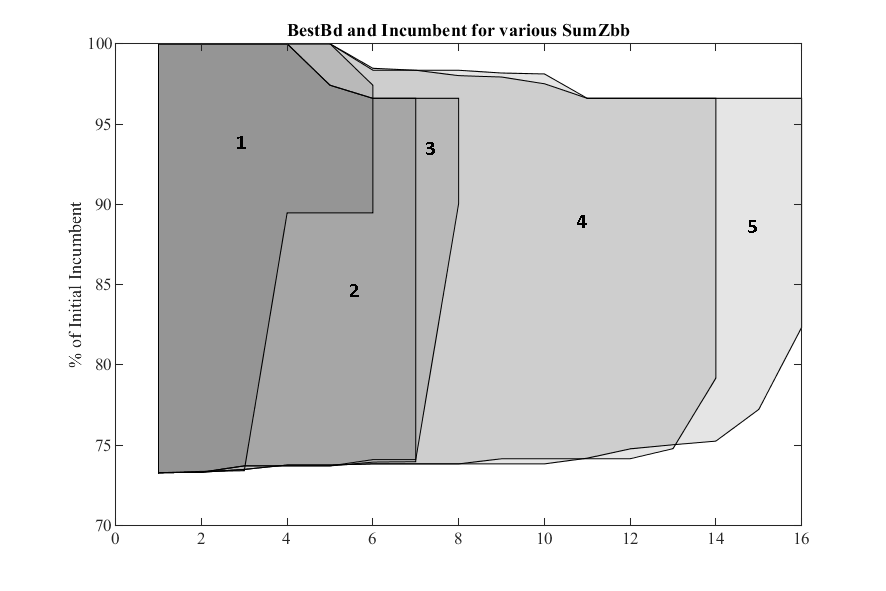
This graph shows that Nmax=2 is sufficient to find the best solution.
My question would then be whether there is any additional insight into my model that I can derive from this (bestBound and Incumbent) performance.
Another question would be whether it is possible to know in advance that Nmax=2 is sufficient, but I suspect that it is not the case.
Thank you very much!
Kind regards,
Mariano
-
Official comment

-
Gurobi Staff
This post is more than two years old. Some information may not be up to date. For current information, please check the Gurobi Documentation or Knowledge Base. If you need more help, please create a new post in the community forum, or try Gurobot, our chatbot interface offering instant, expert-level support. -
-

-
Hi Mariano,
One thing that comes to mind is applying a multi-objective approach: First, optimizing the main model with a large \(N_{max}\) value and in the next step trying to minimize \(\sum x_i\) so you find the smallest number leading to the same solution quality.
You can read more about multi-objective optimization here: Multiple Objectives - Gurobi Optimization
I hope that helps!
Cheers,
Matthias0 -
-

Dear Matthias,
Thank you for the quick response.
I will try that out.
Best regards
Mariano
0 -
Post is closed for comments.
Comments
3 comments