MIP with bilinear constraints not converging for large datasets
Answered
We are trying to minimize the sum of absolute deviations between known values, d(i), and unknown values, b(j) , where x(i,j) is an indicator variable to switch values b(j) on and off:
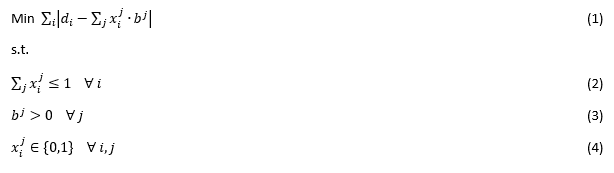
We have transformed this into the following LP problem to eliminate the absolute value:

Note that the set j is typically small, i.e. j = {1,...,4}, but the set i can be rather big. We have had no problems solving this for smaller sets (where i has ~30-50 instances) but it appears the branch-and-cut algorithm is not converging for a large number of instances (~800). The MIP gap stops steadily decreasing after a while and the optimal solution is not identified after many hours.
The output with a run using a set of 50 instances for i is copied below. We wonder if you have any recommendations for us on how to move forward?
Optimize a model with 50 rows, 253 columns and 150 nonzeros
Model fingerprint: 0x23af6a5d
Model has 50 quadratic constraints
Variable types: 103 continuous, 150 integer (150 binary)
Coefficient statistics:
Matrix range [1e+00, 1e+00]
QMatrix range [1e+00, 1e+00]
QLMatrix range [1e+00, 1e+00]
Objective range [1e+00, 1e+00]
Bounds range [1e+00, 1e+00]
RHS range [1e+00, 1e+00]
QRHS range [3e+01, 9e+03]
Presolve removed 8 rows and 40 columns
Presolve time: 0.00s
Presolved: 336 rows, 591 columns, 966 nonzeros
Presolved model has 252 SOS constraint(s)
Variable types: 339 continuous, 252 integer (252 binary)
Found heuristic solution: objective 30730.716060
Root relaxation: objective 2.182787e-11, 194 iterations, 0.00 seconds
Nodes | Current Node | Objective Bounds | Work
Expl Unexpl | Obj Depth IntInf | Incumbent BestBd Gap | It/Node Time
0 0 0.00000 0 55 30730.7161 0.00000 100% - 0s
H 0 0 28667.960880 0.00000 100% - 0s
H 0 0 28370.626800 0.00000 100% - 0s
H 0 0 28339.654500 0.00000 100% - 0s
0 0 0.00000 0 55 28339.6545 0.00000 100% - 0s
H 0 0 23960.171280 0.00000 100% - 0s
H 0 2 20460.301380 0.00000 100% - 0s
0 2 0.00000 0 55 20460.3014 0.00000 100% - 0s
H 26 32 15213.593760 0.00000 100% 6.9 0s
H 31 40 14036.646360 0.00000 100% 6.5 0s
H 230 226 13516.311720 0.00000 100% 2.6 0s
H 231 274 11980.085640 0.00000 100% 2.6 0s
H 579 388 11373.028560 0.00000 100% 2.7 0s
H 855 476 11286.306120 0.00000 100% 2.5 0s
H 1680 882 10096.969800 0.00000 100% 3.0 0s
* 3195 1352 122 9886.3581600 0.00000 100% 2.9 0s
110405 62224 4936.98462 82 25 9886.35816 1672.50420 83.1% 2.3 5s
*158012 86607 123 9824.4135600 1864.53246 81.0% 2.3 7s
*185355 99999 119 9675.7465200 1963.64382 79.7% 2.3 8s
H189299 99353 9366.0235200 1976.03274 78.9% 2.3 8s
H198970 95768 9056.3005200 2013.19950 77.8% 2.3 8s
239464 112753 6863.46168 55 40 9056.30052 2155.67208 76.2% 2.4 10s
378496 167045 7210.35144 82 24 9056.30052 2521.14522 72.2% 2.4 15s
520273 223463 7464.32430 84 25 9056.30052 2787.50700 69.2% 2.4 20s
656735 275370 cutoff 79 9056.30052 2973.34080 67.2% 2.4 25s
800650 328670 cutoff 50 9056.30052 3128.20230 65.5% 2.4 30s
937937 379072 8758.96644 100 16 9056.30052 3245.89704 64.2% 2.4 35s
1063824 422718 4410.45552 76 29 9056.30052 3338.81394 63.1% 2.5 40s
1199580 471967 cutoff 63 9056.30052 3413.14746 62.3% 2.5 45s
1331451 518817 8418.27114 75 25 9056.30052 3481.28652 61.6% 2.5 50s
1454296 564550 infeasible 79 9056.30052 3537.03666 60.9% 2.5 55s
1586617 612777 6045.79296 69 36 9056.30052 3598.98126 60.3% 2.5 60s
1725046 666270 8771.35536 70 23 9056.30052 3648.53694 59.7% 2.5 65s
1861514 719035 7916.51988 71 30 9056.30052 3685.70370 59.3% 2.5 70s
1984004 768786 cutoff 64 9056.30052 3716.67600 59.0% 2.6 75s
2109620 816836 8021.82570 88 21 9056.30052 3747.64830 58.6% 2.6 80s
2240454 865328 cutoff 64 9056.30052 3778.62060 58.3% 2.6 85s
2372751 916189 8523.57696 82 28 9056.30052 3815.78736 57.9% 2.6 90s
2513586 971021 cutoff 62 9056.30052 3834.37074 57.7% 2.6 95s
2646458 1023280 7204.15698 65 47 9056.30052 3865.34304 57.3% 2.6 100s
2774219 1072064 6590.90544 71 24 9056.30052 3890.12088 57.0% 2.6 105s
2894969 1120277 6690.01680 60 51 9056.30052 3921.09318 56.7% 2.6 110s
3027147 1172727 cutoff 73 9056.30052 3933.48210 56.6% 2.6 115s
3150331 1220312 5420.15250 73 25 9056.30052 3958.25994 56.3% 2.6 120s
3287453 1276267 cutoff 68 9056.30052 3970.64886 56.2% 2.6 125s
3418969 1325799 4453.81674 82 25 9056.30052 4001.62116 55.8% 2.6 130s
3533478 1371380 5395.37466 56 62 9056.30052 4020.20454 55.6% 2.6 135s
3648130 1415594 cutoff 73 9056.30052 4038.78792 55.4% 2.6 140s
3781924 1469562 5866.15362 67 34 9056.30052 4057.37130 55.2% 2.6 145s
3912776 1520285 cutoff 73 9056.30052 4075.95468 55.0% 2.6 150s
4041821 1569094 7086.46224 72 35 9056.30052 4094.53806 54.8% 2.6 155s
4159513 1613057 8969.57808 72 39 9056.30052 4119.31590 54.5% 2.6 160s
4286844 1660020 6021.01512 56 63 9056.30052 4137.89928 54.3% 2.6 165s
4423385 1713956 7941.29772 68 30 9056.30052 4156.48266 54.1% 2.6 170s
4543739 1758020 cutoff 66 9056.30052 4175.06604 53.9% 2.6 175s
4680477 1809728 7997.04786 83 24 9056.30052 4193.64942 53.7% 2.6 180s
4817198 1859578 8957.18916 66 36 9056.30052 4212.23280 53.5% 2.6 185s
4950966 1907940 cutoff 60 9056.30052 4237.01064 53.2% 2.6 190s
5085817 1959082 cutoff 68 9056.30052 4249.39956 53.1% 2.6 195s
5209831 2002345 6002.43174 67 42 9056.30052 4267.98294 52.9% 2.6 200s
5333897 2051093 cutoff 73 9056.30052 4280.37186 52.7% 2.6 205s
5461014 2099327 5785.62564 76 31 9056.30052 4298.95524 52.5% 2.6 210s
5592573 2146103 cutoff 65 9056.30052 4311.34416 52.4% 2.6 215s
5722681 2192570 cutoff 69 9056.30052 4329.92754 52.2% 2.6 220s
5839533 2235961 4831.67880 68 29 9056.30052 4342.31646 52.1% 2.6 225s
5946066 2272917 cutoff 75 9056.30052 4360.89984 51.8% 2.6 230s
6046540 2310932 6504.18300 63 47 9056.30052 4367.09430 51.8% 2.6 235s
6160057 2349711 7662.54702 67 30 9056.30052 4379.48322 51.6% 2.6 240s
-
Official comment

-
Gurobi Staff
This post is more than three years old. Some information may not be up to date. For current information, please check the Gurobi Documentation or Knowledge Base. If you need more help, please create a new post in the community forum. Or why not try our AI Gurobot?. -
-

-
Hi Elizabeth,
We can think of improving the performance of Gurobi from two different aspects: modelling and parameter tuning.
Modeling:
- Gurobi supports modelling simple general constraints such as absolute values directly. To model a constraint in the form of y=|x|, you can use the Gurobi general constraint Model.addGenConstrAbs(). As explained in the documentation, each general constraint has an equivalent MIP formulation that consists of linear and SOS constraints, and possibly auxiliary variables. You can model these constraints yourself without using Gurobi general constraints as you already did. However, using Gurobi general constraints might have the extra benefit of simplifying the equivalent MIP formulation.
- Gurobi does not support strict inequality constraints because of the floating-point arithmetic and defining the feasible set as an open set. You need to change b>0 to b≥0 (or to b≥ϵ if you want b to be strictly positive).
- It is a good practice to define lower and upper bounds for the decision variables. You might want to define an upper bound for your decision variables b. Given your model, it seems max(d) would work if d values are always positive.
- Make sure that you are using the latest version of Gurobi Optimizer (version 9.1.2). Running the model on a machine with more cores can help as well.
Parameter tuning:
It would be best if you can share the log file of your hard instance with i={1,2,...,800}. You might want to consider tuning the parameters of your model using the Gurobi Parameter Tuning Tool. This is an automated tool and you do not need to provide any parameter settings. However, if you do not have access to enough computational resources to speed up the tuning process, you can also consider experimenting with the following parameters to gain more insight into your model.
- Presolve=2 and/or PreSparsify=1. The former applies presolving more aggressively and can result into a smaller model to optimize. The latter might help to reduce the number of non-zeros.
- If the best bound is the bottleneck, consider Cuts=2 or 3. This applies cuts more aggressively and can tighten the relaxation, resulting into a tighter bound.
- If the incumbent solution is the bottleneck, consider increasing the amount of time spent in the MIP heuristics by Heuristics=0.1 or higher. You might also want to increase the frequency of applying the RINS heuristic.
- Symmetry, MIPFocus, ImproveStartGap, and ImproveStartTime are other parameters you can consider experimenting with.
- If it is easy to build a good heuristic solution for your model, it is a very good idea to provide that solution as a start solution to Gurobi.
Please consider the above just as guidelines and be aware that parameters in Gurobi are inter-dependent and it is impossible to precisely know their effects rather by experimentation.
Best regards,
Maliheh
1 -
Post is closed for comments.
Comments
2 comments