Difference between (addVars & addVar) and (addConstrs & addConstr)
Answered-
Official comment

-
Gurobi Staff
This post is more than three years old. Some information may not be up to date. For current information, please check the Gurobi Documentation or Knowledge Base. If you need more help, please create a new post in the community forum, or try Gurobot, our chatbot interface offering instant, expert-level support. -
-

-
The addVar method adds a single variable while the addVars method adds multiple variables at once. The addVars method is a convenience method, since you can get the exact same result by using a \(\texttt{for}\)-loop and the addVar method.
import gurobipy as gp

m = gp.Model()
x = m.addVars(3, name="x")
m.update()
print(x)
generates 3 variables named \(\texttt{"x[0]","x[1]","x[2]"}\), which can be accessed via \(\texttt{x[0],x[1],x[2]}\).
The equivalent code using addVar would be
import gurobipy as gp

m = gp.Model()
x = {}
for i in range(3):
    x[i] = m.addVar(name="x[%d]"%i)
m.update()
print(x)
The same difference holds for addConstr and addConstrs. There should be no significant performance difference between the two respective methods.
Usually, adding sets of optimization variables through addVars results in a more concise code.
For constraints, it is recommended to use addConstr if the generated constraints are very complex, i.e., when many \(\texttt{for}\)-loops and \(\texttt{if}\)-clauses are needed to iterate through the indices. Otherwise, using addConstrs to add a set of constraints simultaneously results in a more concise code.
You could browse through the Python examples to get a feeling when to use which method. Our webinar on gurobipy should also bring some clarity.
Best regards,
Jaromił0 -
-

Thanks for a great explanation!
0 -
-

Jaromił Najman already gave a details answer. Thanks.
I just wanted to say one little point (that I keep in mind when it comes to addConstrs vs addConstr)
If you see the following model, the 3rd constraint is a single constraint (use addConstr) whereas 2nd constraint equation will become len(A) numbers of constraints. When we enumerate Equation 2 using index of decision variable x_ij, we get multiple constraints; in such case, lets use addConstrs.
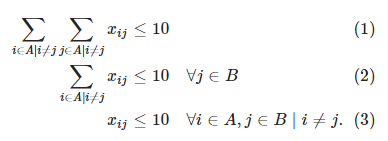
https://or.stackexchange.com/questions/1508/common-structures-in-gurobi-python
0 -
Post is closed for comments.
Comments
4 comments