VRPTW Infeasible
Answered
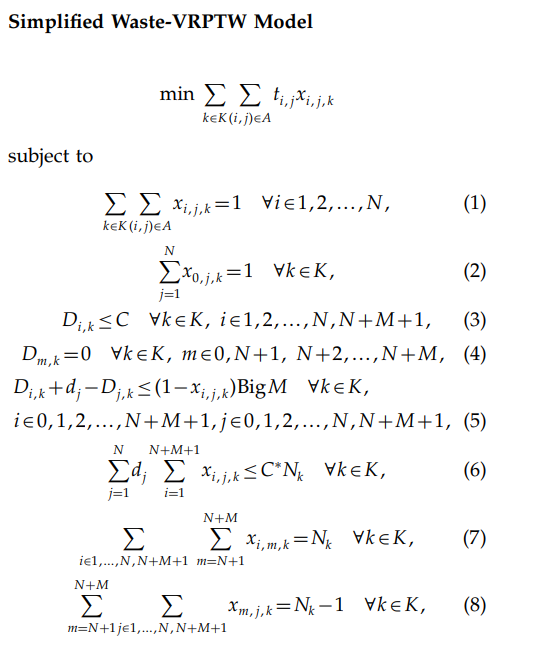
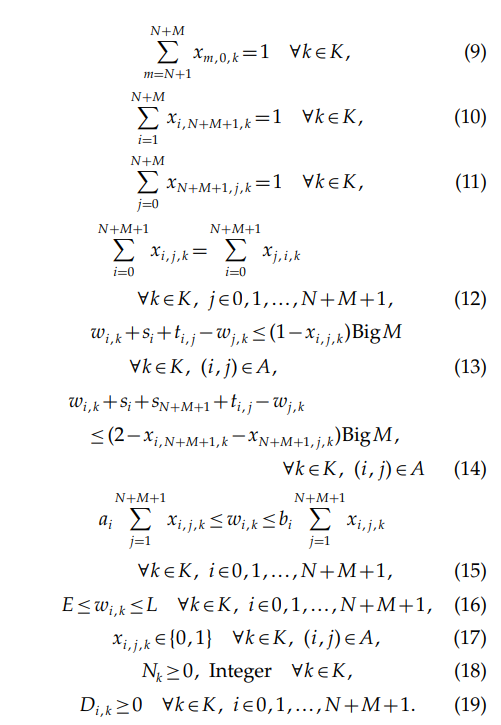
I was trying to code this model in python with gurobi, but I have some problems that caused the infeasible. Here is my code:
from gurobipy import Model, GRB, quicksum
import numpy as np
import pandas as pd
import matplotlib.pyplot as plt
import random
import math
import time

#generate data------------------------------------------------------------------------------
np.random.seed(5)

# Parameters
N = 5  # Number of regular stops
M = 2  # Number of landfills
K = 2  # Number of vehicles
C = 100  # Vehicle capacity

# Generating service times (s_i) for regular stops and landfills (randomly between 0 to 10), depot, and lunch break with 0
service_times = np.concatenate(([0], np.random.randint(0, 11, N + M), [0]))
# Earliest possible departure time from the depot
E = 0
# Latest possible arrival time at the depot
L = 600
# Generating time windows ([a_i, b_i]) for nodes, with the lunch break specifically between 12:00 and 14:00
time_windows_start = np.concatenate(([0], np.random.randint(1, 240, N + M), [4*60]))  # Start times
time_windows_end = np.concatenate(([600], np.random.randint(360, 600, N + M), [6*60]))  # End times

# Generating demands (d_i) for regular stops, with zero demand for landfills, lunch break, and depot
demands = np.concatenate(([0], np.random.randint(10, 30, N), np.zeros(M + 1)))

# Generating travel times (t_ij) between all pairs of nodes, symmetric and random between 1 to 20, zero for self-travel
travel_times = np.random.randint(1, 20, size=(N + M + 2, N + M + 2))
np.fill_diagonal(travel_times, 0)

# Compile generated data into a DataFrame for display
df_data = pd.DataFrame({
    "Service Times": service_times,
    "Time Window Start": time_windows_start,
    "Time Window End": time_windows_end,
    "Demands": demands
})

# Display the DataFrame to verify the generated data
print(df_data)

# Optionally, display the travel times matrix
print("Travel Times Matrix:")
print(travel_times)

#Preparing model------------------------------------------------------------------------------
model = Model("VRPTW")


# Decision Variables
# X[i, j, k]: 1 if vehicle k travels from node i to node j, 0 otherwise
X = model.addVars(N + M + 2, N + M + 2, K, vtype=GRB.BINARY, name="X")

# W[i, k]: Start service time at node i for vehicle k
W = model.addVars(N + M + 2, K, vtype=GRB.CONTINUOUS, name="W")

# D[i, k]: Cumulative demand at node i for vehicle k
D = model.addVars(N + M + 2, K, vtype=GRB.CONTINUOUS, name="D")

for i in range(N + M + 2):
    for k in range(K):
        D[i, k].lb = 0
        D[i, k].ub = C

# Objective Function: Minimize total travel time
model.setObjective(quicksum(X[i, j, k] * travel_times[i, j]
                            for i in range(N + M + 2)
                            for j in range(N + M + 2)
                            for k in range(K)), GRB.MINIMIZE)

# Constraint (1): Each regular stop is served exactly once
for i in range(1, N + 1):
    model.addConstr(quicksum(X[i, j, k] for k in range(K) for j in range(N + M + 2) if j != i) == 1, f"visit_once_{i}")

# Constraint (2): Each vehicle starts from the depot
for k in range(K):
    model.addConstr(quicksum(X[0, j, k] for j in range(1, N + 1)) == 1, f"start_from_depot_{k}")

# Constraint (3): The cumulative demand at each stop for each vehicle must not exceed vehicle capacity
for k in range(K):
    for i in range(1, N + M + 1):  # Assuming that the depot and lunch break do not contribute to the load
        model.addConstr(D[i, k] <= C, f"capacity_{i}_{k}")

# Constraint (4): Cumulative demand is reset to zero at the depot and each landfill
for k in range(K):
    # Reset at the depot (node 0)
    model.addConstr(D[0, k] == 0, f"depot_reset_{k}")
    # Reset at each landfill node
    for m in range(N + 1, N + M + 1):
        model.addConstr(D[m, k] == 0, f"landfill_reset_{m}_{k}")

bigM = 1000

# Constraint (5): Update cumulative demand correctly when a stop is visited
for k in range(K):
    for i in range(N + M + 2):
        for j in range(N + M + 2):
            if i != j:
                model.addConstr(D[i, k] + demands[j] - D[j, k] <= (1 - X[i, j, k]) * bigM, f"cumulative_demand_{i}_{j}_{k}")

# Initialize Nk as integer decision variables for each vehicle
Nk = model.addVars(K, vtype=GRB.INTEGER, name="Nk")

# Landfill nodes indices
landfill_nodes = list(range(N + 1, N + M + 1))

# Add constraints to calculate Nk based on trips to landfill sites
for k in range(K):
    model.addConstr(
        Nk[k] == quicksum(X[i, j, k] for i in range(N + M + 2) for j in landfill_nodes),
        name=f"Nk_calculation_{k}"
    )

# Constraint (6): Ensure the total demand does not exceed the capacity times the number of disposal trips
for k in range(K):
    model.addConstr(
        quicksum(demands[j] * quicksum(X[i, j, k] for i in range(N + M + 2)) for j in range(1, N + 1))
        <= C * Nk[k],
        f"capacity_trips_{k}"
    )

# Constraint (7): Number of trips from the regular stops and the depot to disposal facilities equals Nk
for k in range(K):
    model.addConstr(
        quicksum(quicksum(X[i, m, k] for m in range(N + 1, N + M + 1)) for i in range(N + M + 1))
        == Nk[k],
        f"number_of_disposal_trips_{k}"
    )

# Constraint (8): The number of trips from disposal facilities to the regular stops and the depot is Nk - 1
for k in range(K):
    model.addConstr(
        quicksum(X[m, i, k] for m in range(N + 1, N + M + 1) for i in range(N + M + 2) if i != m) == Nk[k] - 1,
        f"trips_from_disposal_to_stops_{k}"
    )

# Constraint (9): The last trip from a disposal facility for each vehicle is to the depot
for k in range(K):
    model.addConstr(
        quicksum(X[m, 0, k] for m in range(N + 1, N + M + 1)) == 1,
        f"last_trip_to_depot_{k}"
    )

# Constraint (10): Each vehicle arrives at the lunch break from one of the nodes
for k in range(K):
    model.addConstr(
        quicksum(X[i, N + M + 1, k] for i in range(1, N + M + 1)) == 1,
        f"arrive_at_lunch_{k}"
    )

# Constraint (11): Each vehicle departs from the lunch break to one of the nodes
for k in range(K):
    model.addConstr(
        quicksum(X[N + M + 1, j, k] for j in range(N + M + 1)) == 1,
        f"depart_from_lunch_{k}"
    )

# Constraint (12): A vehicle must leave a stop if it arrives at that stop
for k in range(K):
    for j in range(N + M + 2):  # Includes all nodes: stops, landfills, depot, and lunch break
        model.addConstr(
            quicksum(X[i, j, k] for i in range(N + M + 2)) ==
            quicksum(X[j, i, k] for i in range(N + M + 2)),
            f"flow_conservation_{j}_{k}"
        )

# Constraint (13): Time window and service time constraints without lunch break consideration
for k in range(K):
    for i in range(N + M + 2):
        for j in range(N + M + 2):
            if i != j:
                model.addConstr(W[i, k] + service_times[i] + travel_times[i, j] - W[j, k] <= (1 - X[i, j, k]) * bigM, f"time_window_{i}_{j}_{k}")

# Constraint (14): Time window and service time constraints with lunch break consideration
# This constraint will apply to the arcs leading into and out of the lunch break node
for k in range(K):
    for i in range(N + M + 2):
        for j in range(N + M + 2):
            if i != j:
                model.addConstr(W[i, k] + service_times[i] + service_times[N + M + 1] + travel_times[i, j] - W[j, k] <= (2 - X[i, N + M + 1, k] - X[N + M + 1, j, k]) * bigM, f"lunch_break_{i}_{j}_{k}")

# Constraint (15): Service start time must be within the time window of the node
for k in range(K):
    for i in range(N + M + 2):
        model.addConstr(time_windows_start[i] * quicksum(X[j, i, k] for j in range(N + M + 1)) <= W[i, k], f"service_start_earliest_{i}_{k}")
        model.addConstr(W[i, k] <= time_windows_end[i] * quicksum(X[i, j, k] for j in range(N + M + 1)), f"service_start_latest_{i}_{k}")

# Constraint (16): Service start time must be within the overall time horizon
for k in range(K):
    for i in range(N + M + 2):
        model.addConstr(E <= W[i, k], f"overall_horizon_start_{i}_{k}")
        model.addConstr(W[i, k] <= L, f"overall_horizon_end_{i}_{k}")

# Update the model with the new bounds
model.update()

#Optimization------------------------------------------------------------------------------
import time

# Optimize the model
start_time = time.time()  # Start the timer
model.optimize()  # Run the optimization
end_time = time.time()  # End the timer

# Calculate and print the running time
running_time = end_time - start_time
print(f"The optimization ran for {running_time:.4f} seconds")

# Check if the model has been solved to optimality
if model.status == GRB.OPTIMAL:
    print("Optimal solution found.")

    # Print the solution (for example, the service start times for each node and vehicle)
    for k in range(K):
        for i in range(N + M + 2):
            if W[i, k].X > 0:  # Only print times for nodes that are visited
                print(f"Vehicle {k} starts service at node {i} at time {W[i, k].X}")

    # print the routes by checking the values of X[i, j, k]
    for k in range(K):
        for i in range(N + M + 2):
            for j in range(N + M + 2):
                if X[i, j, k].X > 0.5:  # Assuming a binary variable, we check if it's 'active'
                    print(f"Vehicle {k} travels from node {i} to node {j}")

elif model.status == GRB.INFEASIBLE:
    print("The model is infeasible; no solution exists.")
elif model.status == GRB.UNBOUNDED:
    print("The model is unbounded; no optimal solution can be found.")
else:
    print(f"Optimization was stopped with status {model.status}")
0
-
Official comment

-
Gurobi Staff
This post is more than two years old. Some information may not be up to date. For current information, please check the Gurobi Documentation or Knowledge Base. If you need more help, please create a new post in the community forum, or try Gurobot, our chatbot interface offering instant, expert-level support. -
-

-
Please refer to the Knowledge Base articles
0 -
Post is closed for comments.
Comments
2 comments